Written by Liz Lindqwister
Published Aug. 11, 2023 • 5:30am

An Illustration generated by the artificial intelligence program Midjourney depicts two people making out in an autonomous vehicle. San Francisco locals have bragged about their debaucherous exploits while being passengers in robotaxis. | Source:Midjourney
Ever thought about getting down and dirty in a robotaxi? Want to light up a cig or a joint on the drive home from the club? You’re not alone.
As autonomous vehicles become increasingly popular in San Francisco, some riders are wondering just how far they can push the vehicles’ limits—especially with no front-seat driver or chaperone to discourage them from questionable behavior.
For some, that’s a welcome invitation to test the autonomous vehicles’ limits. Megan, a woman in her 20s, took her first robotaxi ride on a recent late-night excursion. It was also her first time having sex in a driverless vehicle. The Standard is not providing exact dates of the riders’ debauchery to protect their privacy but has verified the rides took place through documentation. Names have been changed because of the riders’ privacy concerns.
“We got in and just got straight to it, making out,” said Megan, who got into the Cruise wearing nothing but a robe. “One thing led to another, and he made sure that I was taken care of, if you will. … I was like, ‘I have no underwear on, and I am ready to go in this kimono.’ And I was using his slippers that were like five sizes too big.”

Two Cruise robotaxis wait at a red light on the corner of Eighth and Brannan streets in San Francisco on July 19. | Source:Isaac Ceja/The Standard
Her accomplice? A man in his 30s, whom we’ll call Alex. By his estimates, Alex has performed at least six separate sex acts in robotaxis, ranging from impromptu make-out sessions to “full-on [sex], no boundaries activities” a total of three times in a Cruise car.
“I mean, there's no one to tell you, ‘You can't do that,’” he said, laughing. “It gets to the point where you're more and more and more comfortable, and if you're with someone, like a more serious partner, it can escalate to other activities.”
The Standard has spoken to four separate Cruise car riders who said they’ve had sex or hooked up in the driverless vehicles in San Francisco over recent months and have provided ride receipts. The Standard was unable to find a source who said they’d had sex in a Waymo.
“The vast majority of our riders are respectful and follow our rider rules,” a Waymo spokesman said.
It’s not the first time this creative use of self-driving cars has come up: After Tesla released its autopilot feature nearly a decade ago, CEO Elon Musk went viral for reacting to a Pornhub video of a couple having sex in a Tesla while it was driving on autopilot.
Turns out these rumblings of covert robocar hook-ups might have some basis in science: A little-known 2018 study predicted that more autonomous vehicles would mean more sex on the road—and potentially other unseemly behaviors you likely wouldn’t want your Uber driver to bear witness to.
“It seems like I’m a trailblazer,” Alex said. “It’s also fun to realize that this is like the first place you can do this in the country—the first [autonomous vehicles] that exist.”
The rules and regulations surrounding robotaxis are murky, largely because the industry is so new. Here’s what you can and can’t do in a robotaxi, according to Cruise and Waymo experts, and a couple who has tested the limits of autonomous vehicle debauchery.

The Cruise Origin seats six adults facing one another. | Source ourtesy Cruise
“It was really funny because [the Cruise] got quite hot and fogged up to the point that the windshield was completely fogged over—in any other context, in any other vehicle, that would be an actual problem,” Alex said.
Unfortunately for the debaucherous among us, robotaxi companies currently use pretty extensive camera surveillance inside and outside of their cars.
“We record video inside of the car for added safety and support,” Cruise states on its website. “If something happened during your ride, we might review the recording to better understand what happened. We only record audio during active support calls.”
The company also told The Standard that it is in the “early stages” of developing new sensor features in its Origin cars—the larger, bus-like vehicles—that can detect trash or items left behind.
A Waymo spokesperson said its team might review recordings if there are concerns about cleanliness, safety, crashes or missing items. Yet these surveillance tactics have been met with resistance, particularly from those concerned about how the private companies will use footage collected from previous rides. In San Francisco, police have already made requests for driverless car footage from Waymo and Cruise to help solve crimes, according to Bloomberg reporting.
“I definitely have had anxiety post-situation the next day being like, ‘Oh that wasn’t the best idea,’” Alex said. “There’s a concern you might receive an email or contact from [Cruise]” banning users from the system.

The rear side of a Waymo robotaxi in San Francisco on is seen on July 17. | Source:Isaac Ceja/The Standard
Of course, whatever happens inside a Cruise car is largely visible to bystanders who can peer into the robotaxi's fishbowl-like cab. Megan said that during their robotaxi tryst, once their car took a spin through Golden Gate Park, the recently set-up stage lights for Outside Lands lit up the couple and their “activities.”
“In one instance, an individual outside of the car, in another car, looked in and basically had an understanding of what was happening—and he smiled,” Alex said. “It was not like a negative reaction; it was almost humorous. Certain people have a different threshold of concerns about public ‘situations.’”
But where there’s a will, there’s a way. The 2018 study about sex in autonomous vehicles notes that even as self-driving vehicle companies scale up their surveillance tactics, the truly savvy will always find a way around it—especially in privately owned cars.
“While [autonomous vehicles] will likely be monitored to deter passengers having sex or using drugs in them, and to prevent violence, such surveillance may be rapidly overcome, disabled or removed,” the study said. “Private [autonomous vehicles] may also be put to commercial use, as it is just a small leap to imagine Amsterdam’s Red Light District ‘on the move.’”
“Was it the most comfortable? Was it the most ideal? Probably not,” Megan said. “But the fact that we were out and about in public, the whole taboo of it being kind of wrong made it more fun and exciting.”
Cruise, for example, pleads riders to not do anything in an AV that would “potentially make others uncomfortable” and to avoid activity that could be classified as “threatening, confrontational, discriminatory, harassing, disrespectful, offensive or inappropriate toward others,” according to its terms of service.

An Illustration generated by the artificial intelligence program Midjourney portrays a group of people partying in an autonomous vehicle with the Golden Gate Bridge in the background. | Source:Midjourney
“We're working hard to make sure our service is safe, clean, and open to everyone, and riders agree to do their part when they sign up to use our service,” a Cruise spokesperson said. “We will take appropriate action against anyone who violates those guidelines,” which could include suspending or terminating their Cruise accounts.
Still, it appears most of what you can (and cannot) do in a regular taxicab is also allowed in a Cruise or Waymo: Both companies permit eating in their cars, though the two companies say riders may have to pay an extra service fee if they leave the robotaxis trashed or dirty.
“Waymo One riders are allowed to eat and drink nonalcoholic beverages during their rides,” a Waymo spokesperson said. “There is a reasonable expectation of cleanliness from riders to not leave trash or debris, but the occasional crumbs are human nature.”
But what about passengers?
The state vehicle code is pretty clear on that front: Drivers and passengers are prohibited from drinking alcohol, smoking marijuana or possessing open containers of either substance in cars while on public roads.
A small loophole may exist Under California law: open-container laws do not apply to passengers in a “bus, taxicab, or limousine for hire.” Cruise received permits to operate paid rides in 2022, effectively making its cars driverless taxicabs. Yet the company has apparently cracked down on users its cameras have caught drinking in its vehicles.
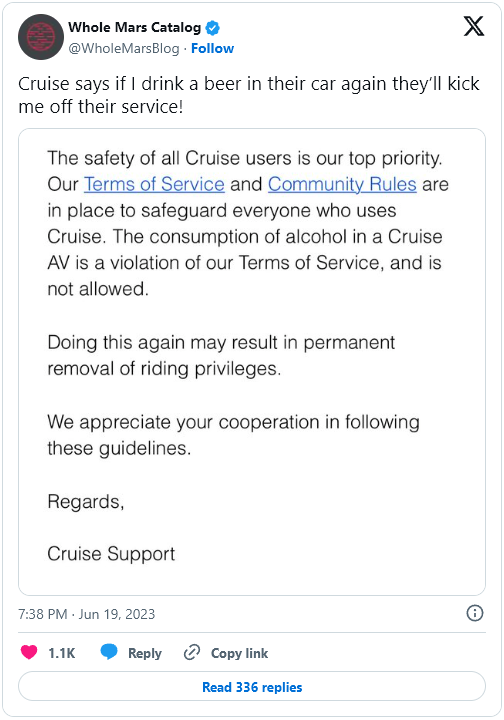
One such passenger, a writer with popular tech social media account Whole Mars Catalog, apparently received a slap on the wrist—a written warning from Cruise—for drinking a beer can in the back seat of a Cruise car.
 Tweet (Archive)
Waymo also explicitly prohibits substance use in its vehicles, “including bringing an open container” on board, the company states on its support site. Though this could easily be a rule required only by the private company, Waymo and other driverless car companies on Thursday won state approval to operate across San Francisco 24/7 and charge passengers for rides.
The California Highway Patrol, which regulates the state vehicle code, was unable to confirm by publication time how the code applies to robotaxis.
Both companies also urge riders not to smoke or vape in their cars, and animals are unfortunately not allowed in either's vehicles.
As for our adventurous couple, Alex and Megan, they said they’d do it all over again.
“I was just along for the ride,” Megan said. “Literally.”
Source (Archive)
Published Aug. 11, 2023 • 5:30am
An Illustration generated by the artificial intelligence program Midjourney depicts two people making out in an autonomous vehicle. San Francisco locals have bragged about their debaucherous exploits while being passengers in robotaxis. | Source:Midjourney
Ever thought about getting down and dirty in a robotaxi? Want to light up a cig or a joint on the drive home from the club? You’re not alone.
As autonomous vehicles become increasingly popular in San Francisco, some riders are wondering just how far they can push the vehicles’ limits—especially with no front-seat driver or chaperone to discourage them from questionable behavior.
For some, that’s a welcome invitation to test the autonomous vehicles’ limits. Megan, a woman in her 20s, took her first robotaxi ride on a recent late-night excursion. It was also her first time having sex in a driverless vehicle. The Standard is not providing exact dates of the riders’ debauchery to protect their privacy but has verified the rides took place through documentation. Names have been changed because of the riders’ privacy concerns.
“We got in and just got straight to it, making out,” said Megan, who got into the Cruise wearing nothing but a robe. “One thing led to another, and he made sure that I was taken care of, if you will. … I was like, ‘I have no underwear on, and I am ready to go in this kimono.’ And I was using his slippers that were like five sizes too big.”
Two Cruise robotaxis wait at a red light on the corner of Eighth and Brannan streets in San Francisco on July 19. | Source:Isaac Ceja/The Standard
Her accomplice? A man in his 30s, whom we’ll call Alex. By his estimates, Alex has performed at least six separate sex acts in robotaxis, ranging from impromptu make-out sessions to “full-on [sex], no boundaries activities” a total of three times in a Cruise car.
“I mean, there's no one to tell you, ‘You can't do that,’” he said, laughing. “It gets to the point where you're more and more and more comfortable, and if you're with someone, like a more serious partner, it can escalate to other activities.”
The Standard has spoken to four separate Cruise car riders who said they’ve had sex or hooked up in the driverless vehicles in San Francisco over recent months and have provided ride receipts. The Standard was unable to find a source who said they’d had sex in a Waymo.
“The vast majority of our riders are respectful and follow our rider rules,” a Waymo spokesman said.
It’s not the first time this creative use of self-driving cars has come up: After Tesla released its autopilot feature nearly a decade ago, CEO Elon Musk went viral for reacting to a Pornhub video of a couple having sex in a Tesla while it was driving on autopilot.
Turns out these rumblings of covert robocar hook-ups might have some basis in science: A little-known 2018 study predicted that more autonomous vehicles would mean more sex on the road—and potentially other unseemly behaviors you likely wouldn’t want your Uber driver to bear witness to.
“It seems like I’m a trailblazer,” Alex said. “It’s also fun to realize that this is like the first place you can do this in the country—the first [autonomous vehicles] that exist.”
The rules and regulations surrounding robotaxis are murky, largely because the industry is so new. Here’s what you can and can’t do in a robotaxi, according to Cruise and Waymo experts, and a couple who has tested the limits of autonomous vehicle debauchery.
The Cruise Origin seats six adults facing one another. | Source
ourtesy CruiseRobot Eyes Everywhere
How much can you get away with in an autonomous vehicle if they’re effectively window-covered hotel rooms on wheels full of cameras that never stop recording?“It was really funny because [the Cruise] got quite hot and fogged up to the point that the windshield was completely fogged over—in any other context, in any other vehicle, that would be an actual problem,” Alex said.
Unfortunately for the debaucherous among us, robotaxi companies currently use pretty extensive camera surveillance inside and outside of their cars.
“We record video inside of the car for added safety and support,” Cruise states on its website. “If something happened during your ride, we might review the recording to better understand what happened. We only record audio during active support calls.”
The company also told The Standard that it is in the “early stages” of developing new sensor features in its Origin cars—the larger, bus-like vehicles—that can detect trash or items left behind.
A Waymo spokesperson said its team might review recordings if there are concerns about cleanliness, safety, crashes or missing items. Yet these surveillance tactics have been met with resistance, particularly from those concerned about how the private companies will use footage collected from previous rides. In San Francisco, police have already made requests for driverless car footage from Waymo and Cruise to help solve crimes, according to Bloomberg reporting.
“I definitely have had anxiety post-situation the next day being like, ‘Oh that wasn’t the best idea,’” Alex said. “There’s a concern you might receive an email or contact from [Cruise]” banning users from the system.
The rear side of a Waymo robotaxi in San Francisco on is seen on July 17. | Source:Isaac Ceja/The Standard
Of course, whatever happens inside a Cruise car is largely visible to bystanders who can peer into the robotaxi's fishbowl-like cab. Megan said that during their robotaxi tryst, once their car took a spin through Golden Gate Park, the recently set-up stage lights for Outside Lands lit up the couple and their “activities.”
“In one instance, an individual outside of the car, in another car, looked in and basically had an understanding of what was happening—and he smiled,” Alex said. “It was not like a negative reaction; it was almost humorous. Certain people have a different threshold of concerns about public ‘situations.’”
But where there’s a will, there’s a way. The 2018 study about sex in autonomous vehicles notes that even as self-driving vehicle companies scale up their surveillance tactics, the truly savvy will always find a way around it—especially in privately owned cars.
“While [autonomous vehicles] will likely be monitored to deter passengers having sex or using drugs in them, and to prevent violence, such surveillance may be rapidly overcome, disabled or removed,” the study said. “Private [autonomous vehicles] may also be put to commercial use, as it is just a small leap to imagine Amsterdam’s Red Light District ‘on the move.’”
The Actual Rules for Riding in Robotaxis
When asked, both Cruise and Waymo sidestepped commenting directly on what is or isn’t allowed in their cars. Megan and Alex, on the other hand, knew what they were up to wasn’t exactly in the terms and conditions.“Was it the most comfortable? Was it the most ideal? Probably not,” Megan said. “But the fact that we were out and about in public, the whole taboo of it being kind of wrong made it more fun and exciting.”
Cruise, for example, pleads riders to not do anything in an AV that would “potentially make others uncomfortable” and to avoid activity that could be classified as “threatening, confrontational, discriminatory, harassing, disrespectful, offensive or inappropriate toward others,” according to its terms of service.
An Illustration generated by the artificial intelligence program Midjourney portrays a group of people partying in an autonomous vehicle with the Golden Gate Bridge in the background. | Source:Midjourney
“We're working hard to make sure our service is safe, clean, and open to everyone, and riders agree to do their part when they sign up to use our service,” a Cruise spokesperson said. “We will take appropriate action against anyone who violates those guidelines,” which could include suspending or terminating their Cruise accounts.
Still, it appears most of what you can (and cannot) do in a regular taxicab is also allowed in a Cruise or Waymo: Both companies permit eating in their cars, though the two companies say riders may have to pay an extra service fee if they leave the robotaxis trashed or dirty.
“Waymo One riders are allowed to eat and drink nonalcoholic beverages during their rides,” a Waymo spokesperson said. “There is a reasonable expectation of cleanliness from riders to not leave trash or debris, but the occasional crumbs are human nature.”
Can You Drink and Be Driven?
Cruise and Waymo like to tout that their cars will never drive drunk, high, or impaired—a position Cruise, in particular, has plugged in its partnership with Mothers Against Drunk Driving.But what about passengers?
The state vehicle code is pretty clear on that front: Drivers and passengers are prohibited from drinking alcohol, smoking marijuana or possessing open containers of either substance in cars while on public roads.
A small loophole may exist Under California law: open-container laws do not apply to passengers in a “bus, taxicab, or limousine for hire.” Cruise received permits to operate paid rides in 2022, effectively making its cars driverless taxicabs. Yet the company has apparently cracked down on users its cameras have caught drinking in its vehicles.
One such passenger, a writer with popular tech social media account Whole Mars Catalog, apparently received a slap on the wrist—a written warning from Cruise—for drinking a beer can in the back seat of a Cruise car.

Waymo also explicitly prohibits substance use in its vehicles, “including bringing an open container” on board, the company states on its support site. Though this could easily be a rule required only by the private company, Waymo and other driverless car companies on Thursday won state approval to operate across San Francisco 24/7 and charge passengers for rides.
The California Highway Patrol, which regulates the state vehicle code, was unable to confirm by publication time how the code applies to robotaxis.
Both companies also urge riders not to smoke or vape in their cars, and animals are unfortunately not allowed in either's vehicles.
As for our adventurous couple, Alex and Megan, they said they’d do it all over again.
“I was just along for the ride,” Megan said. “Literally.”
Source (Archive)


