A world-beating deposit of lithium along the Nevada–Oregon border could meet surging demand for this metal, according to a new analysis.
An estimated 20 to 40 million tonnes of lithium metal lie within a volcanic crater formed around 16 million years ago. This is notably larger than the lithium deposits found beneath a Bolivian salt flat, previously considered the largest deposit in the world.
‘If you believe their back-of-the-envelope estimation, this is a very, very significant deposit of lithium,’ says Anouk Borst, a geologist at KU Leuven University and the Royal Museum for Central Africa in Tervuren, Belgium. ‘It could change the dynamics of lithium globally, in terms of price, security of supply and geopolitics.’
New in situ analysis reveals that an unusual claystone, composed of the mineral illite, contains 1.3% to 2.4% of lithium in the volcanic crater. This is almost double the lithium present in the main lithium-bearing clay mineral, magnesium smectite, which is more common than illite.
Some unusual conditions created what could be a uniquely rich volcanic deposit. The crater – the McDermitt caldera – formed 16.4 million years ago when around 1000km3 of magma exploded outwards. The caldera was filled with erupted products of an alkaline magma rich in sodium and potassium, as well as lithium, chlorine and boron. This quickly cooled to form a finely crystalline glassy volcanic rock, ignimbrite, which weathered to produce lithium-rich particles.
A lake subsequently formed in the crater, persisting for hundreds of thousands of years, with weathered volcanic and surrounding materials forming a clay-rich sediment at its bottom. The new analysis suggested that, after the lake had emptied, another bout of volcanism exposed the sediments to a hot, alkaline brine, rich in lithium and potassium.
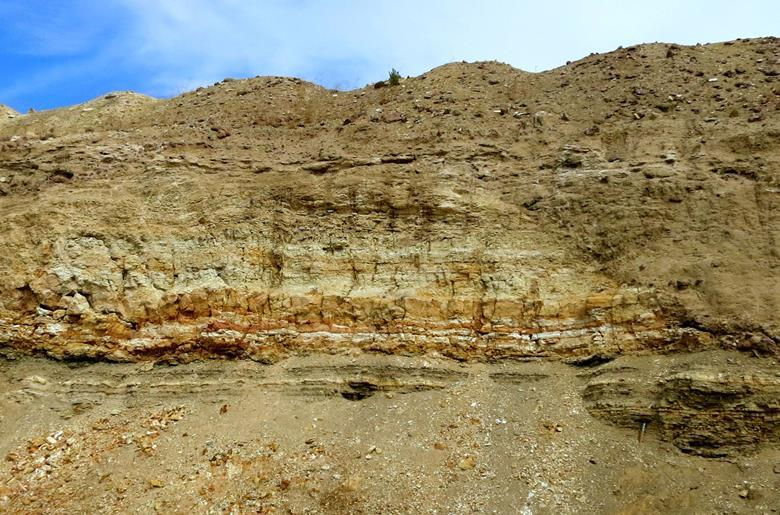
Source: © Chris Henry
Layers of claystone containing lithium minerals in the McDermitt caldera
Previous research assumed that the illite was everywhere at depth in the caldera,’ says Thomas Benson, a geologist at Lithium Americas Corporation, and was formed when high temperatures and pressures turned smectite to illite.
Benson’s team proposed that a layer of illite around 40m thick was formed in the lake sediments by this hot brine. The fluid moved upwards along fractures formed as volcanic activity restarted, transforming smectite into illite in the southern part of the crater, Thacker Pass. The result was a claystone rich in lithium.
‘This would be a multistep alteration of lithium-bearing smectite to illite, where hydrothermal fluids enriched the clays in potassium, lithium and fluorine,’ says Borst. ‘They seem to have hit the sweet spot where the clays are preserved close to the surface, so they won’t have to extract as much rock, yet it hasn’t been weathered away yet.’
The material could be best described as looking ‘a bit like brown potter’s clay’, says Christopher Henry, emeritus professor of geology at the University of Nevada in Reno. ‘It is extremely uninteresting, except that it has so much lithium in it.’
‘There’s been a lot of searching for additional [lithium] deposits,’ Henry adds. ‘The United States has just one small lithium-producing brine operation in Nevada.’
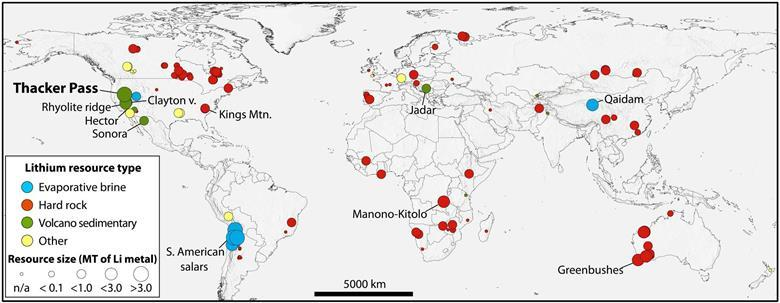
Source: © Benson et al., Sci. Adv. 9 (2023)
Map showing type and relative size of global lithium resources. Current production is predominantly spodumene from pegmatites in Australia (47%) and brines underlying salt flats in Chile (30%), China (12%), and Argentina (5%)
Henry does not wholly agree with the newly proposed history of the crater, since isotopic dating showed that a lake existed there until 15.7 million years ago, but the volcanic system went extinct by 16.1 million years. The new timeline would require volcanic activity for longer than the evidence suggests, he explains.
Benson says his company expects to begin mining in 2026. It will remove clay with water and then separate out the small lithium-bearing grains from larger minerals by centrifuging. The clay will then be leached in vats of sulfuric acid to extract lithium.
‘If they can extract the lithium in a very low energy intensive way, or in a process that does not consume much acid, then this can be economically very significant,’ says Borst. ‘The US would have its own supply of lithium and industries would be less scared about supply shortages.’
Benson views the lithium-rich claystone at Thacker Pass as ‘unique’ amongst volcanic sedimentary deposits. ‘Smectite clays are relatively more abundant,’ he says. Exploration for further lithium deposits following eruptions should focus on calderas with lake sediments that have been hydrothermally altered in lakes with no outflows, he adds.
Article Link
Archive
An estimated 20 to 40 million tonnes of lithium metal lie within a volcanic crater formed around 16 million years ago. This is notably larger than the lithium deposits found beneath a Bolivian salt flat, previously considered the largest deposit in the world.
‘If you believe their back-of-the-envelope estimation, this is a very, very significant deposit of lithium,’ says Anouk Borst, a geologist at KU Leuven University and the Royal Museum for Central Africa in Tervuren, Belgium. ‘It could change the dynamics of lithium globally, in terms of price, security of supply and geopolitics.’
New in situ analysis reveals that an unusual claystone, composed of the mineral illite, contains 1.3% to 2.4% of lithium in the volcanic crater. This is almost double the lithium present in the main lithium-bearing clay mineral, magnesium smectite, which is more common than illite.
Some unusual conditions created what could be a uniquely rich volcanic deposit. The crater – the McDermitt caldera – formed 16.4 million years ago when around 1000km3 of magma exploded outwards. The caldera was filled with erupted products of an alkaline magma rich in sodium and potassium, as well as lithium, chlorine and boron. This quickly cooled to form a finely crystalline glassy volcanic rock, ignimbrite, which weathered to produce lithium-rich particles.
A lake subsequently formed in the crater, persisting for hundreds of thousands of years, with weathered volcanic and surrounding materials forming a clay-rich sediment at its bottom. The new analysis suggested that, after the lake had emptied, another bout of volcanism exposed the sediments to a hot, alkaline brine, rich in lithium and potassium.
Source: © Chris Henry
Layers of claystone containing lithium minerals in the McDermitt caldera
Previous research assumed that the illite was everywhere at depth in the caldera,’ says Thomas Benson, a geologist at Lithium Americas Corporation, and was formed when high temperatures and pressures turned smectite to illite.
Benson’s team proposed that a layer of illite around 40m thick was formed in the lake sediments by this hot brine. The fluid moved upwards along fractures formed as volcanic activity restarted, transforming smectite into illite in the southern part of the crater, Thacker Pass. The result was a claystone rich in lithium.
‘This would be a multistep alteration of lithium-bearing smectite to illite, where hydrothermal fluids enriched the clays in potassium, lithium and fluorine,’ says Borst. ‘They seem to have hit the sweet spot where the clays are preserved close to the surface, so they won’t have to extract as much rock, yet it hasn’t been weathered away yet.’
The material could be best described as looking ‘a bit like brown potter’s clay’, says Christopher Henry, emeritus professor of geology at the University of Nevada in Reno. ‘It is extremely uninteresting, except that it has so much lithium in it.’
‘There’s been a lot of searching for additional [lithium] deposits,’ Henry adds. ‘The United States has just one small lithium-producing brine operation in Nevada.’
Source: © Benson et al., Sci. Adv. 9 (2023)
Map showing type and relative size of global lithium resources. Current production is predominantly spodumene from pegmatites in Australia (47%) and brines underlying salt flats in Chile (30%), China (12%), and Argentina (5%)
Henry does not wholly agree with the newly proposed history of the crater, since isotopic dating showed that a lake existed there until 15.7 million years ago, but the volcanic system went extinct by 16.1 million years. The new timeline would require volcanic activity for longer than the evidence suggests, he explains.
Benson says his company expects to begin mining in 2026. It will remove clay with water and then separate out the small lithium-bearing grains from larger minerals by centrifuging. The clay will then be leached in vats of sulfuric acid to extract lithium.
‘If they can extract the lithium in a very low energy intensive way, or in a process that does not consume much acid, then this can be economically very significant,’ says Borst. ‘The US would have its own supply of lithium and industries would be less scared about supply shortages.’
Benson views the lithium-rich claystone at Thacker Pass as ‘unique’ amongst volcanic sedimentary deposits. ‘Smectite clays are relatively more abundant,’ he says. Exploration for further lithium deposits following eruptions should focus on calderas with lake sediments that have been hydrothermally altered in lakes with no outflows, he adds.
Article Link
Archive


