The following analysis of the legality of lolicon is going to be integrated into the
Jordan Williams / Mimi Yanagi thread OP and should not be taken as legally authoritative since it is not written by a judge.
United States
In the USA there are three laws which ban sexually explicit images of children:
18 US Code 2252,
18 US Code 2252A, and
18 US Code 1466A. 2252 has a slightly higher proof requirement than 2252A, although it is the most commonly prosecuted of these three laws, at least in 2011 and 2012 per data from
Project Safe Childhood in 2016.

We will, however, focus on 2252A and 1466A, since these were created for the purpose of prohibiting fictional child pornography. 2252A prohibits any child pornography as defined by
18 US Code 2256, which in brief is any photographic or "deep-fake" image of a minor, and although the child depicted must be an identifiable minor, since there is no requirement to prove the identity of the child, any sufficiently photorealistic depiction of a fake child will be prosecuted under this law.
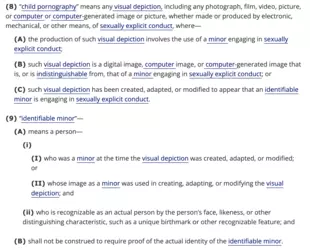
1466A, on the other hand, prohibits any obscene and sexually explicit visual depiction of a minor in any medium whatsoever, including cartoons. Furthermore, it is not necessary that such obscene work depicts a real minor, as did some works of
Shaddai Prejean, but it is sufficient if it appears to depict a minor. The penalty imposed by 1466A is identical to the penalty imposed by 2252A, which prohibits CSAM of real minors, and the
United States Sentencing Commission assigns the same offense level to crimes against 2252, 2252A, and 1466A.


1466A and 2252A in their substantially present forms were created by the
PROTECT Act of 2003, which was a renewal of the prior laws against child pornography, which had been struck down as unconstitutional due to poor wording causing potential infringements upon free speech. In that prior law, the
Child Pornography Prevention Act of 1996, fictional child pornography was prohibited under 18 US Code 2252A. The reason why it is necessary to ban fictional child pornography is given in the findings report of that law. Although there are other reasons mentioned, the most important are the following, or in other words child pornography stimulates and strengthens the sexual appetites of pedophiles, creates and secures pedophiles in their perversions, and empowers pedophiles to more ably groom children.

Although this law only concerned images which are virtually indistinguishable from depictions of real minors, this deficiency was corrected by the later PROTECT Act along with the other deficiencies generally of CPPA 1996, which deficiencies caused it to be struck down as unconstitutional.
Before moving on, we would do well to mention the fact that those in possession of CSAM and predators are very frequently in possession of fictional child pornography and especially anime child porn. This can be shown by the testimony of several US law enforcement officers such as
Christopher Janczewski, the UK government in their
Consultation on Possession of Non-Photographic Visual Depictions of Child Sexual Abuse, predator hunters such as
Schlep, website administrators such as
@Null who have had to deal with CSAM spammers, and from real world cases of possession such as
Elijah Millar, who has been charged with possession of both CSAM and lolicon images, and
Dwight Whorley who was convicted for possession of both CSAM and lolicon images. Furthermore, some pedophiles are lolicons who refer to their CSAM as lolicon, such as
Lacari/Tramell Tennyson, an OTK adjacent Twitch streamer and lolicon who leaked his CSAM notepad on livestream, which contained links titled L0LIC0N TEENS and Real_Family_Nudism, and
Lonny Ditirro, who labeled one of his CSAM folders as "real lolicon".


(Child erotica is material that is sexually arousing to pedophiles but not necessarily obscene or sexually explicit, as mentioned by Officer Janczewski)


Starts at 3:30:00 (
1 |
2 |
3)


 Taken from Rob's Media

Obscenity and Free Speech
As I said above, the 1996 law was struck down as unconstitutional due to deficiencies in its wording which rendered it an overreach with respect to restrictions on speech. This was instigated by the Free Speech Coalition in
Ashcroft v. Free Speech Coalition under the pretense that the government has no authority to ban fictional child pornography. Due to the effects of this decision most child pornography was legal in practice for a period of about one year, as the findings for the
PROTECT Act mention.

Furthermore, pedophiles were greatly emboldened by the legalization of child pornography, as is mentioned in
H. Rept. 107-526.


Now, although the consequences of this decision were terrible in the short term, in the long term the decision was beneficial, since it led to the creation of a much superior law, the above mentioned PROTECT Act. This law is far superior both due to its increased scope, in which all obscene and sexually explicit child pornography is banned, whereas the prior law only banned photorealistic child pornography. Secondly, it is superior by more effectively ensuring the right to free speech than the prior law, which could be interpreted as banning protected speech. It does this by explicitly only banning obscene works.

The prior law banned all fictional child pornography regardless of whether it was obscene. In practice, there is no difference between these two laws, since there is no such thing as non-obscene child pornography, however the government is not willing to make such a claim since it does not pretend to be the authority on such matters. The same thing is stated by NCMEC in
S. Rept. 108-2.

Some readers may be surprised at the mention of unprotected speech since it is a common misconception that the 1st amendment protects all speech, and, to borrow a phrase from a pedophile, that freedom of speech "exists to protect transgressive speech." In reality, the protection of speech guaranteed by the 1st amendment and other such free speech laws is meant to ensure the general right to the freedom of expression under the natural law and does not extend to all speech whatsoever, as is mentioned by
Robertson v. Baldwin and
Roth v. United States.


The current standard for obscenity used by the United States was defined in
Miller v. California.

"Appeals to the prurient interest" means that it is likely to incite lust in its intended audience.
United Kingdom
Similarly to the United States, child porn is banned under two different statutes in the UK. The
Protection of Children Act 1978 Section 1 bans indecent photographs and pseudo-photographs (deep-fakes) of real children, and the
Coroners and Justice Act 2009 Section 62 bans obscene and pornographic images of children. The material banned by the latter is substantially identical to 18 US Code 1466A, although the wording is different. There is a misconception about the UK law which ought to be clarified. Namely, it is commonly believed that the UK banned lolicon because they are anti-free speech. On the contrary, the UK banned lolicon in part because the United States had already banned lolicon, as the Home Office says in its
Consultation on Possession of Non-Photographic Visual Depictions of Child Sexual Abuse. Therefore, there is no intrinsic attack on free speech present in this law.

Furthermore, they gave sufficient consideration of the right to free speech when formulating this law, since the UK does guarantee the right to free speech in their laws, although this right is in a sorry state in their country.

Presuming that Jordan is only charged under the Coroners and Justice Act 2009, he faces up to 3 years in prison per count, which is less than the statutory maximum of 5 years for possession of CSAM in the UK, since unlike the United States, possession of obscene materials is a lesser offense with a lesser punishment compared to possession of CSAM.


