https://www.washingtonpost.com/nation/2026/05/04/idaho-dairy-farmers-immigration-zuiderveld/
https://archive.ph/JNGyQ

Idaho state Sen. Glenneda Zuiderveld with her husband, Tom Zuiderveld, outside their home in Twin Falls, Idaho, last month. (Kim Raff/For The Washington Post)
By Karin Brulliard
TWIN FALLS, Idaho — The call came as Tom Zuiderveld was driving last month, just minutes from his home on five verdant acres of Southern Idaho’s agricultural heartland. It was his district manager, relaying that three of the dairies he sold synthetic oil to had refused to continue working with him.
Zuiderveld felt blindsided — he had known the dairy owners for years, and the accounts represented 80 percent of his income. But it wasn’t about his performance, the manager explained on the phone and in a later email. It was about the politics of Zuiderveld’s wife.
Glenneda Zuiderveld is a Republican state senator and member of a far-right bloc that was pushing for strict immigration laws. Idaho’s dairy industry, which powers the economy of the Magic Valley region anchored by Twin Falls, depends on foreign-born labor and fiercely opposed the measures.
To the Zuidervelds, the rupture was simple retaliation that illustrates just how bitterly personal American politics has become — an “ambush,” Tom Zuiderveld said, that cost the couple as much as $125,000 in commission a year. To the businesses, which are dominated by Republicans in this deep red state, the moves were fair game in an essential effort to protect the nation’s third-largest dairy industry.
“We live in a free country, and we can actually do business with whoever we want to,” said Arie Roeloffs, owner of Riverbend Dairy, which in April became the fourth to cut ties with Zuiderveld, who is his wife’s campaign treasurer. “What his wife is doing in the state legislature are things that I don’t agree with. And he stands behind her.”
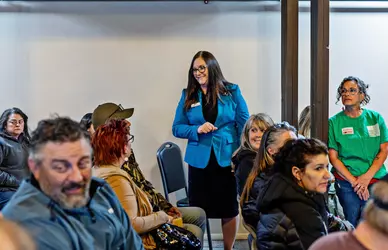
State Sen. Glenneda Zuiderveld (R) talks with attendees at the Wendell Senior Center during a Gooding County GOP debate on April 16 in Wendell, Idaho. (Kim Raff/For The Washington Post)
The schism illustrates a caustic split in Idaho’s Republican Party, in which Glenneda Zuiderveld’s hard-right wing regularly breaks with more traditional GOP members, often over spending but also immigration. That divide reflects an escalating national fault line among Republicans over whether President Donald Trump’s immigration crackdown should spare no mercy for agriculture and other businesses that depend on unauthorized foreign-born labor or, as the White House has signaled, approach them with leniency and even new forms of work permits.
Which side will prevail in Idaho will become clearer after the Republican primary on May 19, which essentially serves as the general election in many districts of a state that has grown more red amid a recent influx of conservatives from blue states. The Idaho Dairymen’s Association, whose members employ about 4,500 people — 90 percent immigrants, many without legal work permits — views the vote as one of the most consequential yet.
“We’ve seen Republicans openly hostile to farmers, which is extremely unusual,” said Rick Naerebout, the association’s chief executive. “This will be a potential tipping point for Idaho: Do we continue to shift further to the right, or do we moderate some? It feels very much like that’s what’s at stake for us, especially in agriculture.”
The Zuiderveld case, which the senator wrote about in a Substack postthat included the email her husband received from his employer, isn’t the first time immigration and agriculture politics have turned personal in the Idaho GOP. Last year, federal officers raided the farm of a moderate Republican state representative, Stephanie Mickelsen, after a far-right activist reported her businesses to an Immigration and Customs Enforcement tip line. One worker with a criminal record was taken into custody, according to InvestigateWest.
The dairy owners who ended their working relationships with Tom Zuiderveld declined in-depth interviews. Naerebout said they also fear being targeted. But he added that their decisions were not only about Glenneda Zuiderveld’s stance on immigration and that they do not see her husband as an innocent bystander: He is her campaign treasurer, and she supports his oil sales job in an administrative role.
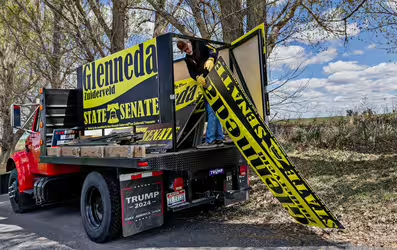
Tom Zuiderveld puts up campaign signs for his wife in the yards of her supporters in Gooding County, Idaho, last month. (Kim Raff/For The Washington Post)
Naerebout called the immigration bills “out-of-state ideas” foisted on Idaho by groups such as the conservative Heritage Foundation, which opposes amnesty for undocumented farmworkers. All failed after pushback from law enforcement, clergy and businesses, which argued that mass deportations would tank Idaho’s economy.
But Glenneda Zuiderveld insists they were not outside ideas at all. Illegal immigration, she said, is one of her constituents’ top complaints. Amnesty for dairy workers who entered the country without permission is unfair, they tell her, as is mercy for employers who she called their “accomplices.”
“Agriculture and dairy, they might have the money behind them. But they don’t have the votes and they don’t really understand the area,” Zuiderveld said. “They’re not really listening to the concerns of their neighbors.”
In an interview at their kitchen table, the Zuidervelds said they are mostly getting by on savings as Glenneda Zuiderveld, 59, campaigns across the Magic Valley, where she has lived since she was a small child. Her parents were potato farmers, and her husband’s worked in dairy. They met when she was in high school, married and had three boys.
The dairy industry, they say, has been interwoven into their lives. They attended church with one of the dairy families that broke ties with Zuiderveld’s husband. Tom Zuiderveld worked for years as a dairy cow hoof trimmer. Glenneda Zuiderveld worked in dairy offices, where she says she made no secret of her feelings about “illegals” but befriended Latino employees, whom she saw as “very family oriented people.”
She said she also saw that they were sometimes unfairly docked pay — a sign, she believed, of an abusive system — and contended that the rare American workers never lasted because the immigrants “made it so miserable for them.”
Though he knew they saw the issue differently, Tom Zuiderveld said he still found the dairies’ impersonal rejection shocking. “You couldn’t have come to me first?” he said. “They did exactly what they wanted to do: send a message.”
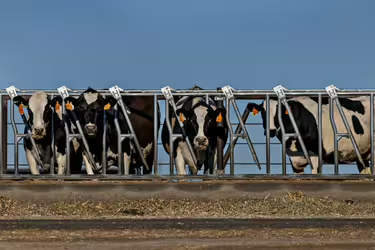
Dairy cows in Gooding County, Idaho. (Kim Raff/For The Washington Post)
Glenneda Zuiderveld has represented her sprawling district since 2022, when she won her first primary by 37 votes, a gap she expanded to 828 in 2024. She initially campaigned on “health freedom” for nurses who opposed vaccine requirements and vows to expose corruption. She has since pushed for displaying the Ten Commandments in schools, voted for the nation’s strictest bathroom bill and backed the anti-spending platform of her ultraconservative “Gang of Eight,” part of the State Freedom Caucus Network.
In 2024, Zuiderveld co-sponsored an unsuccessful resolution calling on Congress to impeach former president Joe Biden over what the Idaho state lawmakers said were immigration failures and societal ills caused by “cheap immigrant labor.”
Dairy lobbyists’ efforts to appeal to her faith — by urging her to care for “the least of these” — do not sway her, she said.
“That’s in our personal capacity, not in our official capacity,” she said. “You don’t get to use somebody else’s tax dollars to take care of the lesser of these.”
Idaho dairies all remain family owned, but consolidation has made many into large operations that struggle to find nonimmigrant workers willing to labor for hours in muck and cold, Naerebout said. The companies adhere to federal laws when hiring workers, he said, and concede that applicants might use fake documents.
The association, like other dairy groups, has long pushed Congress to create visas for their year-round industry, which cannot access the seasonal visas crop farms use. In the meantime, it has opposed conservative Idaho lawmakers’ immigration proposals, including bills requiring businesses to use E-Verify, an electronic system that checks new hires’ documents against federal records. It should be on the federal government, not employers, to determine workers’ legal status, Naerebout said.

“This will be a potential tipping point for Idaho: Do we continue to shift further to the right, or do we moderate some?” says Rick Naerebout, the Idaho Dairymen's Association CEO, shown here last month in Twin Falls, Idaho. (Kim Raff/For The Washington Post)
The Magic Valley has the highest proportion of Latinos in Idaho, and Naerebout said most dairy workers are Mexican. Twin Falls was for years a major refugee resettlement site, a source of both diversity and occasional friction. Since Trump suspended most refugee admissions last year, only a few White South Africans have arrived.
But the subject of immigrants remains fraught.
The owner of Millenkamp Cattle, which owns two of the companies that stopped working with Tom Zuiderveld, did not respond to a request for comment. Roeloffs, in a brief phone interview, said he believes the federal government needs to handle immigration reform, and added that he objected even more strongly to Glenneda Zuiderveld’s votes against funding for water projects. Hank Hafliger, the owner of Cedar Ridge Dairy, echoed that in a statement.
“The Senator has attempted to frame this as a single-issue decision, but the reality is it was the combination of all her votes and statements around various agricultural issues that brought our decision to a head,” Hafliger said, adding that her district is “completely dependent on agriculture and food production, and we struggle to find a single meaningful bill she has advocated for in support of her constituent farmers and food processors in her time in Boise.”
Glenneda Zuiderveld disputes that her work has been anti-agriculture. “Why would I want to destroy the industry that built our livelihood?” she said.
Zuiderveld’s primary opponent, and the dairy industry’s pick, is Brent Reinke, a county commissioner and former state corrections director who says his priorities are “God, family and farming.” In an interview, Reinke said he supports Trump’s border policies but views state-level immigration mandates as locally problematic. E-Verify is a “good program” that could burden Magic Valley employers, and requiring local sheriffs to enforce immigration law would strain the local jails and cost taxpayers, he said.

Brent Reinke, left, who is running for state Senate in Idaho, sets up his display at the Wendell Senior Center during a Gooding County GOP debate last month. (Kim Raff/For The Washington Post)
“What’s the impact next week, next month, and next year?” Reinke said. “Those are the kind of things that I think we need to get back to, instead of the radical approach that if it has a federal dollar attached to it, it’s a no vote. It’s almost like a burn-it-down mentality.”
The tensions over immigration were on display at a recent luncheon sponsored by the Magic Valley Republican Women at a Mexican restaurant in the small town of Buhl. As servers chatting in Spanish delivered meals, Zuiderveld and three other state lawmakers recapped the legislative session.
But attendees asked only about illegal immigration. One man said California, where he used to live, had been “turned into the hell hole it is today” after President Ronald Reagan granted amnesty to nearly 3 million undocumented immigrants in 1986. A woman said immigrants were “still milking off us, even with a job.” Another woman said her teenagers could never get work on dairies or farms that employed foreign-born workers.
“What are y’all looking at doing, not just to the illegals, but the businesses, farms, dairies and others that are hiring them?” she said.
Just one attendee, an 83-year-old woman, urged a different view. She said she spent most of her life in the California dairy industry after immigrating from Portugal.
“Immigration, it’s a wonderful thing,” she said. “Just think about where your people came from. Be generous with your thoughts.”

Attendees listen as Idaho state Sen. Glenneda Zuiderveld (R) debates challenger Brent Reinke at the Wendell Senior Center. (Kim Raff/For The Washington Post)
At their home the next day, the Zuidervelds said they were in lockstep when it came to immigration policy.
Dairies may need immigrant workers, Tom Zuiderveld said, but “that’s breaking the law. As a nation of laws, where do we start determining which laws are okay to break?”
Glenneda Zuiderveld said she supports some sort of “sponsorship” program but thinks those who qualify must pay a penalty — “some kind of justice.”
When she went into politics, she said, she knew her views might eventually jeopardize their income. On Friday, her husband lost another dairy account.
But she feels confident voters will stand by her.
“When it comes election time,” she said, “I think the joke is I probably won the election but we lost our home.”
https://archive.ph/JNGyQ

Idaho state Sen. Glenneda Zuiderveld with her husband, Tom Zuiderveld, outside their home in Twin Falls, Idaho, last month. (Kim Raff/For The Washington Post)
By Karin Brulliard
TWIN FALLS, Idaho — The call came as Tom Zuiderveld was driving last month, just minutes from his home on five verdant acres of Southern Idaho’s agricultural heartland. It was his district manager, relaying that three of the dairies he sold synthetic oil to had refused to continue working with him.
Zuiderveld felt blindsided — he had known the dairy owners for years, and the accounts represented 80 percent of his income. But it wasn’t about his performance, the manager explained on the phone and in a later email. It was about the politics of Zuiderveld’s wife.
Glenneda Zuiderveld is a Republican state senator and member of a far-right bloc that was pushing for strict immigration laws. Idaho’s dairy industry, which powers the economy of the Magic Valley region anchored by Twin Falls, depends on foreign-born labor and fiercely opposed the measures.
To the Zuidervelds, the rupture was simple retaliation that illustrates just how bitterly personal American politics has become — an “ambush,” Tom Zuiderveld said, that cost the couple as much as $125,000 in commission a year. To the businesses, which are dominated by Republicans in this deep red state, the moves were fair game in an essential effort to protect the nation’s third-largest dairy industry.
“We live in a free country, and we can actually do business with whoever we want to,” said Arie Roeloffs, owner of Riverbend Dairy, which in April became the fourth to cut ties with Zuiderveld, who is his wife’s campaign treasurer. “What his wife is doing in the state legislature are things that I don’t agree with. And he stands behind her.”
State Sen. Glenneda Zuiderveld (R) talks with attendees at the Wendell Senior Center during a Gooding County GOP debate on April 16 in Wendell, Idaho. (Kim Raff/For The Washington Post)
The schism illustrates a caustic split in Idaho’s Republican Party, in which Glenneda Zuiderveld’s hard-right wing regularly breaks with more traditional GOP members, often over spending but also immigration. That divide reflects an escalating national fault line among Republicans over whether President Donald Trump’s immigration crackdown should spare no mercy for agriculture and other businesses that depend on unauthorized foreign-born labor or, as the White House has signaled, approach them with leniency and even new forms of work permits.
Which side will prevail in Idaho will become clearer after the Republican primary on May 19, which essentially serves as the general election in many districts of a state that has grown more red amid a recent influx of conservatives from blue states. The Idaho Dairymen’s Association, whose members employ about 4,500 people — 90 percent immigrants, many without legal work permits — views the vote as one of the most consequential yet.
“We’ve seen Republicans openly hostile to farmers, which is extremely unusual,” said Rick Naerebout, the association’s chief executive. “This will be a potential tipping point for Idaho: Do we continue to shift further to the right, or do we moderate some? It feels very much like that’s what’s at stake for us, especially in agriculture.”
The Zuiderveld case, which the senator wrote about in a Substack postthat included the email her husband received from his employer, isn’t the first time immigration and agriculture politics have turned personal in the Idaho GOP. Last year, federal officers raided the farm of a moderate Republican state representative, Stephanie Mickelsen, after a far-right activist reported her businesses to an Immigration and Customs Enforcement tip line. One worker with a criminal record was taken into custody, according to InvestigateWest.
The dairy owners who ended their working relationships with Tom Zuiderveld declined in-depth interviews. Naerebout said they also fear being targeted. But he added that their decisions were not only about Glenneda Zuiderveld’s stance on immigration and that they do not see her husband as an innocent bystander: He is her campaign treasurer, and she supports his oil sales job in an administrative role.
Tom Zuiderveld puts up campaign signs for his wife in the yards of her supporters in Gooding County, Idaho, last month. (Kim Raff/For The Washington Post)
Naerebout called the immigration bills “out-of-state ideas” foisted on Idaho by groups such as the conservative Heritage Foundation, which opposes amnesty for undocumented farmworkers. All failed after pushback from law enforcement, clergy and businesses, which argued that mass deportations would tank Idaho’s economy.
But Glenneda Zuiderveld insists they were not outside ideas at all. Illegal immigration, she said, is one of her constituents’ top complaints. Amnesty for dairy workers who entered the country without permission is unfair, they tell her, as is mercy for employers who she called their “accomplices.”
“Agriculture and dairy, they might have the money behind them. But they don’t have the votes and they don’t really understand the area,” Zuiderveld said. “They’re not really listening to the concerns of their neighbors.”
In an interview at their kitchen table, the Zuidervelds said they are mostly getting by on savings as Glenneda Zuiderveld, 59, campaigns across the Magic Valley, where she has lived since she was a small child. Her parents were potato farmers, and her husband’s worked in dairy. They met when she was in high school, married and had three boys.
The dairy industry, they say, has been interwoven into their lives. They attended church with one of the dairy families that broke ties with Zuiderveld’s husband. Tom Zuiderveld worked for years as a dairy cow hoof trimmer. Glenneda Zuiderveld worked in dairy offices, where she says she made no secret of her feelings about “illegals” but befriended Latino employees, whom she saw as “very family oriented people.”
She said she also saw that they were sometimes unfairly docked pay — a sign, she believed, of an abusive system — and contended that the rare American workers never lasted because the immigrants “made it so miserable for them.”
Though he knew they saw the issue differently, Tom Zuiderveld said he still found the dairies’ impersonal rejection shocking. “You couldn’t have come to me first?” he said. “They did exactly what they wanted to do: send a message.”
Dairy cows in Gooding County, Idaho. (Kim Raff/For The Washington Post)
Glenneda Zuiderveld has represented her sprawling district since 2022, when she won her first primary by 37 votes, a gap she expanded to 828 in 2024. She initially campaigned on “health freedom” for nurses who opposed vaccine requirements and vows to expose corruption. She has since pushed for displaying the Ten Commandments in schools, voted for the nation’s strictest bathroom bill and backed the anti-spending platform of her ultraconservative “Gang of Eight,” part of the State Freedom Caucus Network.
In 2024, Zuiderveld co-sponsored an unsuccessful resolution calling on Congress to impeach former president Joe Biden over what the Idaho state lawmakers said were immigration failures and societal ills caused by “cheap immigrant labor.”
Dairy lobbyists’ efforts to appeal to her faith — by urging her to care for “the least of these” — do not sway her, she said.
“That’s in our personal capacity, not in our official capacity,” she said. “You don’t get to use somebody else’s tax dollars to take care of the lesser of these.”
Idaho dairies all remain family owned, but consolidation has made many into large operations that struggle to find nonimmigrant workers willing to labor for hours in muck and cold, Naerebout said. The companies adhere to federal laws when hiring workers, he said, and concede that applicants might use fake documents.
The association, like other dairy groups, has long pushed Congress to create visas for their year-round industry, which cannot access the seasonal visas crop farms use. In the meantime, it has opposed conservative Idaho lawmakers’ immigration proposals, including bills requiring businesses to use E-Verify, an electronic system that checks new hires’ documents against federal records. It should be on the federal government, not employers, to determine workers’ legal status, Naerebout said.

“This will be a potential tipping point for Idaho: Do we continue to shift further to the right, or do we moderate some?” says Rick Naerebout, the Idaho Dairymen's Association CEO, shown here last month in Twin Falls, Idaho. (Kim Raff/For The Washington Post)
The Magic Valley has the highest proportion of Latinos in Idaho, and Naerebout said most dairy workers are Mexican. Twin Falls was for years a major refugee resettlement site, a source of both diversity and occasional friction. Since Trump suspended most refugee admissions last year, only a few White South Africans have arrived.
But the subject of immigrants remains fraught.
The owner of Millenkamp Cattle, which owns two of the companies that stopped working with Tom Zuiderveld, did not respond to a request for comment. Roeloffs, in a brief phone interview, said he believes the federal government needs to handle immigration reform, and added that he objected even more strongly to Glenneda Zuiderveld’s votes against funding for water projects. Hank Hafliger, the owner of Cedar Ridge Dairy, echoed that in a statement.
“The Senator has attempted to frame this as a single-issue decision, but the reality is it was the combination of all her votes and statements around various agricultural issues that brought our decision to a head,” Hafliger said, adding that her district is “completely dependent on agriculture and food production, and we struggle to find a single meaningful bill she has advocated for in support of her constituent farmers and food processors in her time in Boise.”
Glenneda Zuiderveld disputes that her work has been anti-agriculture. “Why would I want to destroy the industry that built our livelihood?” she said.
Zuiderveld’s primary opponent, and the dairy industry’s pick, is Brent Reinke, a county commissioner and former state corrections director who says his priorities are “God, family and farming.” In an interview, Reinke said he supports Trump’s border policies but views state-level immigration mandates as locally problematic. E-Verify is a “good program” that could burden Magic Valley employers, and requiring local sheriffs to enforce immigration law would strain the local jails and cost taxpayers, he said.

Brent Reinke, left, who is running for state Senate in Idaho, sets up his display at the Wendell Senior Center during a Gooding County GOP debate last month. (Kim Raff/For The Washington Post)
“What’s the impact next week, next month, and next year?” Reinke said. “Those are the kind of things that I think we need to get back to, instead of the radical approach that if it has a federal dollar attached to it, it’s a no vote. It’s almost like a burn-it-down mentality.”
The tensions over immigration were on display at a recent luncheon sponsored by the Magic Valley Republican Women at a Mexican restaurant in the small town of Buhl. As servers chatting in Spanish delivered meals, Zuiderveld and three other state lawmakers recapped the legislative session.
But attendees asked only about illegal immigration. One man said California, where he used to live, had been “turned into the hell hole it is today” after President Ronald Reagan granted amnesty to nearly 3 million undocumented immigrants in 1986. A woman said immigrants were “still milking off us, even with a job.” Another woman said her teenagers could never get work on dairies or farms that employed foreign-born workers.
“What are y’all looking at doing, not just to the illegals, but the businesses, farms, dairies and others that are hiring them?” she said.
Just one attendee, an 83-year-old woman, urged a different view. She said she spent most of her life in the California dairy industry after immigrating from Portugal.
“Immigration, it’s a wonderful thing,” she said. “Just think about where your people came from. Be generous with your thoughts.”

Attendees listen as Idaho state Sen. Glenneda Zuiderveld (R) debates challenger Brent Reinke at the Wendell Senior Center. (Kim Raff/For The Washington Post)
At their home the next day, the Zuidervelds said they were in lockstep when it came to immigration policy.
Dairies may need immigrant workers, Tom Zuiderveld said, but “that’s breaking the law. As a nation of laws, where do we start determining which laws are okay to break?”
Glenneda Zuiderveld said she supports some sort of “sponsorship” program but thinks those who qualify must pay a penalty — “some kind of justice.”
When she went into politics, she said, she knew her views might eventually jeopardize their income. On Friday, her husband lost another dairy account.
But she feels confident voters will stand by her.
“When it comes election time,” she said, “I think the joke is I probably won the election but we lost our home.”


