Fun facts!

  • Want to keep track of this thread?
    Accounts can bookmark posts, watch threads for updates, and jump back to where you stopped reading.
    Create account
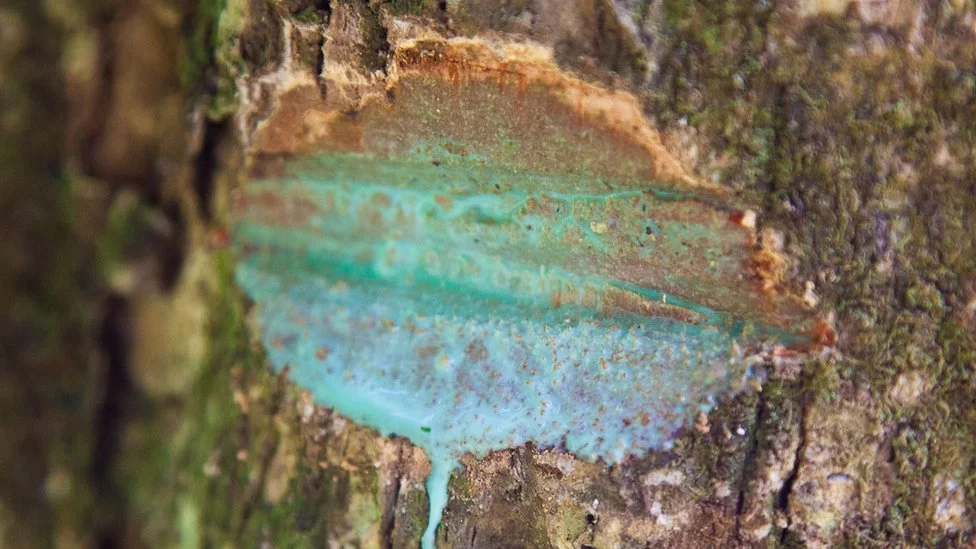
In New Caledonia there is a tree that sequesters nickel out of its volcanic soil to such an extreme degree that its sap is a blue-green color and concentrations of nickel in it are up to 25%. It is Pycnandra acuminata.
_103274907_pycnandra_acuminata_2.webp
Nickel is normally very, very toxic for plants. So this extreme adaptation is very remarkable and it's thought that this may be an adaptation to make the nickel that it absorbs from the soil less toxic. Personally I think that may be a bonus, but I hypothesize that it's also an adaptation to make parasitic plants incapable of parasitizing it. It may even make it harder for fungi to attack it. Additionally when a tree dies the toxic sap within the log will prevent it from being a nurse log for other species who can't tolerate the nickel concentrations.

Meanwhile in Socotra, an island in the Socotra archipelago south of Arabia and east of the Horn of Africa, there is another tree with peculiar sap. The "Socotra Dragon Tree" or "Dragon Blood Tree" is one of a few surviving members of a group of trees that used to span from the Canary Islands, into North Africa and over into Socotra. However much of North Africa is absent of these trees nowadays because of the more arid climate after the end of the Ice Age.

As you can imagine, the Dragon Blood Tree is called such because it has blood-like sap, which is actually called Dragon's Blood. The sap from this tree has been used for a whole variety of things. The related and remaining Canary Island Dragon Trees also produce a similar kind of sap.
Dragonblood_tree_in_Socotra_2.webp
Here is some of its sap too:
unnamed_1_3aa75dcc-b50e-43d7-9b77-6f5980f5a295.webp
 
Yes. It spread through bodily fluids and the virus being present in their semen would be a good indicator that they could still infect people. It may be a really reduced risk of infection compared to other methods, but the risk is still there.
Like the long term question is how bola just pops up from nowhere and kills entire village.
A passerby having a one night stand just became very viable option.
 
Like the long term question is how bola just pops up from nowhere and kills entire village.
A passerby having a one night stand just became very viable option.
Ebola is also a virus that is naturally present in bats too. That's one of the ways it just appears. A lot of zoonotic diseases are very harmful for people and a lot of the most deadly diseases to mankind are often zoonotic in origin. For the poor villages affected by it, someone just needs to get infected from a bat they had hunted and were processing and then it can spread amongst them and devastate the whole community.
 
According to my partner who is a doctor, the rhythm of Staying Alive for performing CPR was changed to this because the old song was Another One Bites the Dust.
 
There exists an electrostatic equivalent to a permanent magnet, electrets. The best way to understand them is that they are basically a very long-lived equivalent to a statically charged balloon like in this pic:

Make-Your-Hair-Stand-on-End-Science-Experiment-Step-3.webp
They can be formed with a variety of dielectric materials(dielectric materials are also used for capacitors), but to my knowledge the very first were produced with kinds of wax. You leave the molten wax to very slowly solidify whilst passing a high voltage current through it. This causes the wax to forcibly align its positive ends and negative ends on a molecular level. As the wax cools and solidifies it keeps this arrangement and so one end is very positively charged and the other is very negatively charged. At least that's how I understand it.

I think they're an underutilized tool, but they do have some applications in some appliances and bits of tech. I think they'd be very useful for cleaning certain surfaces as they can negate or overwhelm the static charge holding various kinds of small dust and debris onto a surface. They also pull water towards them instead of pushing it away like a strong magnet will do. Water is repelled by magnets due to it being diamagnetic. Diamagnetic materials are repelled by any magnetic field, as opposed to being attracted to either pole or to magnetic fields themselves like with paramagnetic materials(Which aren't your typical magnets, those would be made with ferromagnetic materials).
 
The really large cardboard boxes used to transport produce on big trucks are called gaylords. They're named after the Gaylord shipping company who initially designed and sold the very large boxes. If you drive down the highway there's a good chance you're going to see a whole bunch of gaylords.
 
There's at least one species of fungus that grows its mushrooms underwater. Psathyrella aquatica is a more recently discovered fungus, only being described in 2010.
Psathyrella_sp._162027.webp
Speaking of water and Oregon, there's also a whole lake that fills up and then drains every year. "Lost Lake", one of many lakes in Oregon that holds that name, is a lake with lava tubes open at its bottom. When meltwater fills it up it forms a temporary lake before the lava tubes completely drain it. I'd love to know what it's like in those tubes, I hypothesize that some really cool cave life might be in there. That surge of water and organic matter must provide tons of food for a potential biosphere in there.
MKAQBX3BYVFEFE35WRLRXY4B5M.webp
Not far from Oregon, over in Washington, massive events of water collecting and then horrifyingly bursting forth and flooding were happening not too long ago. These floods, known as the "Missoula Floods", would've happened whilst native Americans were in the area and to my memory natives to the American Northwest have flood survival stories in their history and mythology. They may have very well been originally from these very real and devastating events. PBS Eons did a really good video covering it all as well.
 
Cnidaria, the group that stinging jellyfish(what is colloquially called a jellyfish is very broad), corals and anemones all belong to is a very ancient split in the animal family tree. They're believed to be the closest living group to Bilaterians, the group we belong to, and are included with us in a group called "Planulozoa" which references the planula larvae of many cnidarians(and some other groups too).

Cnidaria is a very alien group though. People are all too familiar with jellyfish and corals, but they also have a whole group of microscopic parasites. The Myxozoa(means "slime animal") have thousands of species and parasitize all sorts of animals. Some species don't even use oxygen like we do and have lost their ability to respire aerobically. They don't just parasitize aquatic animals either, they even parasitize some birds and mammals too. Here's a microscopic image of one.
Fdl17-9-grey.webp
And just as well, their life cycle in this diagram.
Myxozoans_Life_Cycle.webp
Beyond them are the sea pens, which are still known by quite a lot of people but still unknown to most people. I have no real facts about sea pens, other than that they're related to corals, they're just cool and neat looking.
Sea-pen.webp
Here's a nice video from the BBC showing off some seapens. It also shows them deflating.
The last alien branch to cover for Cnidaria itself is the Siphonophores. They're part of Hydrozoa, the group that the regenerative freshwater Hydras belong to. Just as well, anytime you see a freshwater jellyfish it's likely to be Hydrozoan. One species, originally from China, Craspedacusta sowerbii has become invasive in various parts of the world. Siphonophores themselves though are not like the hydras or freshwater jellyfish, instead they're colonies of clones that all are fused together and each one holds a special function. Some parts digest food, other maintain buoyancy, others have tentacles and hunt and so on. One of the longest animal recorded so far is a siphonophore as well, Praya dubia. Here's a picture of it.
150-Foot_Siphonophore.webp
Siphonophores come in many odd varieties though. Here are a few videos of some odd siphonophores to finish off this post.
A dandelion siphonophore:
A not so clear siphonophore, but the publisher of the video thinks it may be a Bathyphysa species.
 
Geckos have a transparent layer of tissue covering their eyes called a "brille", which is a trait they convergently evolved with snakes(who have a transparent scale covering their eyes). However this doesn't apply to all geckos, the colloquially known "eyelid geckos" or Eublepharidae do in fact have eyelids. Their group contains the most popular gecko pet, the leopard gecko.
Eublepharis_macularius1.webp
Unfortunately leopard geckos are pajeets :(. They originate from a region that overlaps both Pakistan and India. It even overlaps somewhat into Afghanistan.
Eublepharis_macularius_distribution.webp
Leopard gecko babies are very cute and will "REEEE" when scared.
Another popular gecko pet is the mourning gecko. Mourning geckos are very famous for their nearly all-female, parthenogenic(parthenos = virgin, genic refers to birth in this case) nature. Males do sometimes occur but are very rare and often sterile. Their parthenogenic habit makes them very easy to breed and when left alone with plenty of hides to lay their eggs(and for the babies to hide because they're cannibalistic) they'll quickly produce tons of new geckos(but you need two geckos to start it off, iirc they have to simulate the act of copulation to trigger the process). They also love fruit and mushy foods. Someone on YouTube has made a video of them doing Yoshi sounds while feeding.
 
Fun fact: I like turtles.
In Australasia, the area the encompasses Australia, Papau New Guinea, many islands and New Zealand, there used to exist a whole group of large, horned and club-tailed turtles. Meiolania is the genus I'm referring to. Other members, of the larger group of club-tailed turtles they belong to, Meiolaniidae also existed in South America and some of which were also horned.
Meiolania_AMNH.webp
Some of these species would've existed alongside humans potentially as some specimens may only be 2-3 thousand years old. I hope that we can get DNA from them so that we could potentially de-extinct them. They'd make cool pets.

Speaking of cool pets: Mud, musk and stinkpot turtles are a large group of very small turtles from the Americas. The largest species from this group only grows to have a foot long shell, most individuals are much smaller.
Sternotherus_odoratus.webp
Some species are kept in captivity and some species can live to be 50 years or older. Their babies are also very, very small. Here's a video showing some baby loggerhead musk turtles. Just as well, a screencap showing one of the babies next to a quarter.
Screenshot 2025-05-09 184108.webp
Clint at Clint's Reptiles on YouTube also did a video both covering these kinds of turtles as pets, which included their baby versions. According to his video some states may prohibit the sale of babies due to them not being a certain size.
Onto other kinds of turtles, sea turtles are very cool. Even though they are often preyed upon by sharks, they can actually thwart most sharks by doing a kind of dance with them. They repeatedly swim to keep the flat portion of their shell to face the shark as it comes to bite them. Here's a video of that where the turtle, near the end of the video, bites back at the shark and goes for a ride :). Also don't worry too much about the damage to the shell, to them it's like your fingernail. They don't feel much through it.
 
Gold is a very unreactive metal. Normally the metals are all quite reactive. For gold this is because it belongs to the group known as the noble metals, which includes other precious metals like palladium, platinum and der Erverlerd's favorite of silver. However the noble metals also sometimes includes metals you wouldn't expect, like mercury which is a very dangerous heavy metal. This is because elemental mercury is actually not a very reactive metal, which is why in dry, clean, room-temperature air it won't tarnish or for its oxide. The danger of mercury comes from organic mercury compounds.

Gold, like mercury though, can interact with organic molecules. Cyanide will react with gold in a process called "gold cyanidation", as will silver. This process is actually a very popular and still used mining technique that works especially well on ore that has lots of gold atoms present but lacks in larger, solid chunks of gold that could instead be panned out. It's especially useful in situations where the ore is so low grade that trying to smelt the gold out with any other process is useless. What is instead done, via this cyanidation process, is what is often referred to as "heap leaching", where a large heap of the crushed ore is laid somewhere with cyanide and water then being sprinkled on top. The cyanide and water will pick up gold(and often silver too) atoms and then drain out of the bottom and into a basin. Here's a diagram of that.
4361681.webp

Related to gold mining, many people in history have wanted to collect gold from seawater. In fact, the oceans contain very vast, but dilute quantities of minerals. This is due to the fact that all of the weathered rock from continental sources will drain its mineral laden waters to the Ocean. Further underwater volcanoes directly dump their contents into the ocean.

The practice for trying to extract minerals from seawater is under the collective label of "brine mining". Fritz Haber, the man who helped revolutionize fertilizer production with the Haber-Bosch process, tried to pursue extracting gold from seawater to try and repay Germany's war debt after WW1. He ultimately concluded that it wouldn't be profitable.

Many organisms actually produce cyanide, even some animals. Most famously there are species of millipedes that will produce hydrogen cyanide to defend themselves. The "cyanide millipede" is one such example. Cyanide is so poisonous in most life because of how it interferes with the electron transport chain of most life and for Eukaryotes(the group we, plants and fungi all belong to) our mitochondria. However plants are immune to this as they use ubiquinone instead of the Complex IV system that other organisms use. To quote from the wikipedia article on cyanide poisoning:
Cyanide is a broad-spectrum poison because the reaction it inhibits is essential to aerobic metabolism; COX is found in multiple forms of life. However, susceptibility to cyanide is far from uniform across affected species; for instance, plants have an alternative electron transfer pathway available that passes electrons directly from ubiquinone to O2, which confers cyanide resistance by bypassing COX.

This means that it is in theory possible to use gold cyanidation to collect gold from seawater. The best candidate would be a gelatinous animal that also leaves mineral deposits. This would naturally bring one to corals. All you'd need is to make species of coral who not only produce cyanide, but also have a method to pop the gold off and into the calcium carbonate they sequester to build their skeletons. This would turn the coral skeletons of this species into a low grade gold ore, with the added advantage that when crushed it and heated it would also produce lime which is already very necessary in gold cyanidation.

Remember to support your local mad scientist into making gold ore producing corals :). Have some pictures of cool corals too.
shutterstock_387066889.webp
bladefirecoral3.webp
Favites_abdita.webp
 
Back
Top Bottom