The Kiwi Farms was targeted with a historic DDoS attack last week. Confirmed reports of 2.8Tbps on an individual provider, topping 4.8Tbps when known volumes are added together, and possibly up to 8Tbps if the attacker is believed. This is the third of fourth largest recorded.
Want to keep track of this thread?
Accounts can bookmark posts, watch threads for updates, and jump back to where you stopped reading. Create account
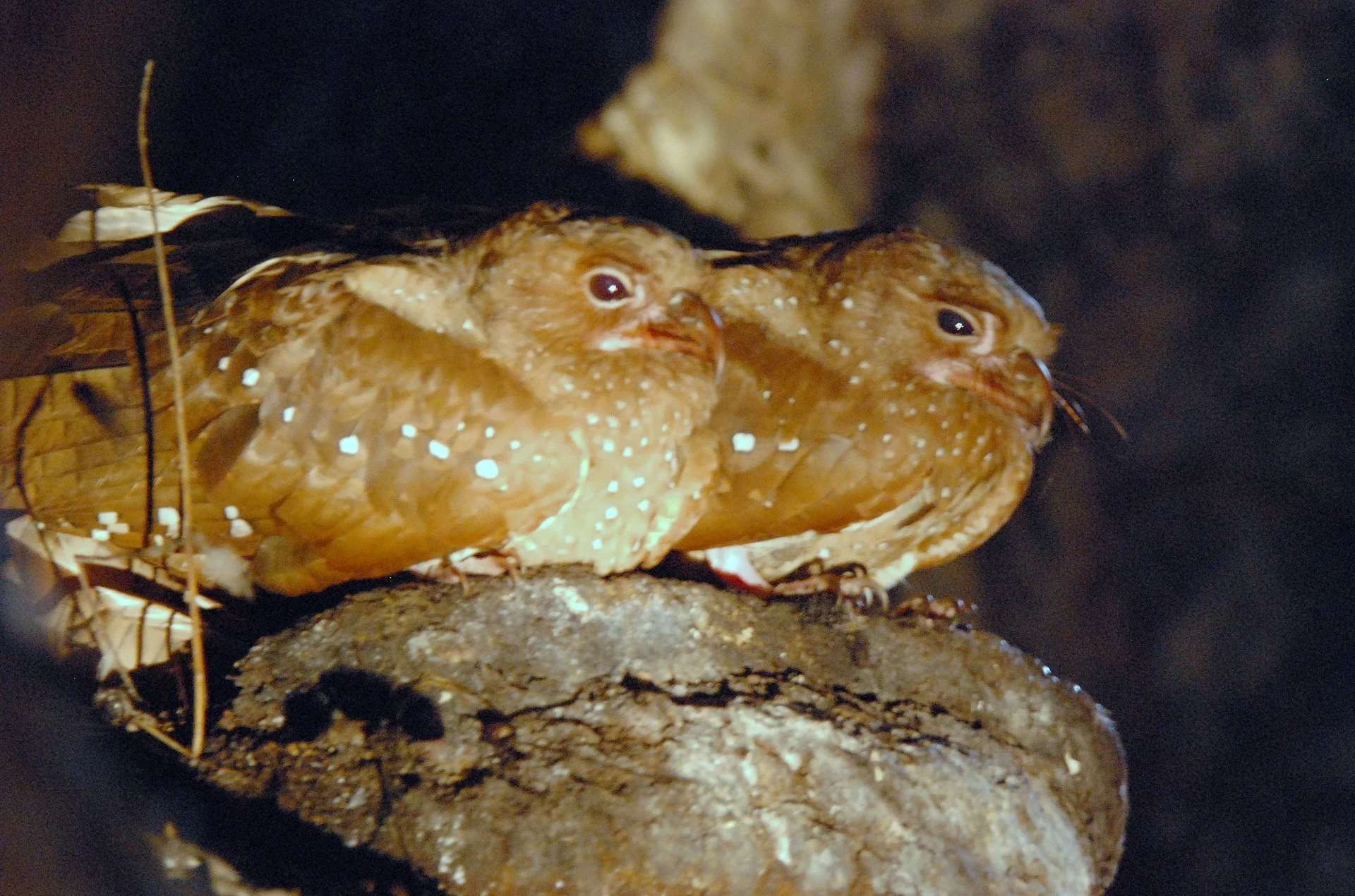
The South American oilbird or guacharo is a nocturnal frugivore(eats mostly fruit) that uses echolocation. They often live in caves and their echolocation is essential to landing back in their nests. They also, even though they can echolocate, have some of the best night vision of any bird. Birds typically have very poor night vision, unlike mammals.
Also they're cute.
What is instead done, via this cyanidation process, is what is often referred to as "heap leaching", where a large heap of the crushed ore is laid somewhere with cyanide and water then being sprinkled on top. The cyanide and water will pick up gold(and often silver too) atoms and then drain out of the bottom and into a basin. Here's a diagram of that.
Like the long term question is how bola just pops up from nowhere and kills entire village.
A passerby having a one night stand just became very viable option.
Mostly animal reservoirs where the host animal isn't affected seriously or at all by the virus.
It's actually a good thing it's so deadly and kills so quickly, because it is usually self-containing. A mutation that gave it a longer latency period without decreasing its deadliness could be a species ender, or at least seriously cull the herd.
The South American oilbird or guacharo is a nocturnal frugivore(eats mostly fruit) that uses echolocation. They often live in caves and their echolocation is essential to landing back in their nests. They also, even though they can echolocate, have some of the best night vision of any bird. Birds typically have very poor night vision, unlike mammals. View attachment 7354913
Also they're cute.
Some of the coolest places on the planet to me are hellholes(toxic or otherwise) .
If I was rich I'd be making cool wildlife exhibits/zoos/aquariums from modified life made to live in toxic hellholes that you'd only be able to look at due to how horrific the conditions are. Thankfully I'm a very poor man so the biohazards I'd make are only trapped in my mind. However nature makes her own toxic hellholes, Mono Lake being one of them. It's a highly salty and alkaline lake that's incredibly toxic. Few animals live inside of it, but what does is highly specialized and odd. From the less odd brine shrimp that inhabit it, to the akali flies that graze on its algae and have adaptations to resist the "stickier water" of the lake that otherwise drowns other insects, to nematodes that give live birth, can handle extremely high arsenic levels and have three sexes. You also have a kind of choanaflagellate(relatives to animals, often single-celled) who not only resemble what the earliest animal life is thought to have looked like but weirdly keep bacterial colonies within them.
PBS's Deep Look channel also has a wonderful video on the Alkali flies.
The elites don't want you to know this but the oilbirds' extremely good night vision and echolocation let's them find out all of the entrances to Deep Underground Military Bases("DUMBs" for short). They've seen the Clinton's kill list and witnessed the reptilians. Luckily they have the worst poker faces in the animal kingdom. Maybe one day we can learn to interrogate them to find out more.
In New Caledonia there is a tree that sequesters nickel out of its volcanic soil to such an extreme degree that its sap is a blue-green color and concentrations of nickel in it are up to 25%. It is Pycnandra acuminata.
I recall there being a plant that can be mined for metal as it sucks up metals in such doses that it can be processed, smelted. Potentially useful for cleaning up industrial/batttlefield sites.
Nazi Germany genuinely had plans to make U-boats capable of launching V2 rockets (via a container which would be towed) and one of goals of the project was to strike American cities like New York with them. More info
I recall there being a plant that can be mined for metal as it sucks up metals in such doses that it can be processed, smelted. Potentially useful for cleaning up industrial/batttlefield sites.
Yeah there's a whole bunch of potential plants and fungi for bioremediation. That tree from New Caledonia could potentially be tapped to collect its nickel rich sap which could then be dried or cooked down into a syrup and then smelted down or chemically processed further to recover nickel. People have been using plants in particular to get certain kinds of minerals for a long while though. The vast majority of soap from ancient peoples, when it didn't come from something like soaproot(which can be used directly as a replacement for soap), was made from the ashes of hardwood trees and various fats and oils.
This is actually where the name for potassium comes from, as it references potash. Likewise the Venetians for their superior quality glass of the time relied on a kind of halophyte(halo = salt, phyte = plant) to get soda ash. This is one of those halophytes, and it's a plant that accumulates sodium. Soda ash can also be used to make soap too .
Related to the talk of toxic hellholes earlier and also superfund sites, one of the ways to actually get these kinds of plants is to have areas that are overwhelmingly laden with some kind of material to the point that it's toxic. For the halophytes, it's seasalt. For the tree from New Caledonia it's the nickel in the rocks. This is because some of the ways to both deal with highly toxic environments and to avoid predation/grazing is to accumulate that toxin in a form that is more inert for you. It's doubly good if it's totally inert unless digestive enzymes hit it.
It may sound kind of counter intuitive to take in a toxin and build it up, but it helps to think of it like this: We ourselves actually have mechanisms to pull certain problem elements out of us. Most other organisms have them too, but in the case for those organisms useful for bioremediation they just don't release the toxins they've dealt with as an adaptation. In halophytes this can be useful more directly in having osmotic parity with seawater(thus they don't get dehydrated being in seawater from water leaving them to enter the saltier water) or even accumulating water from seawater by being saltier than it.
On toxic hellholes, there's a poisonous and noxious cave in Romania that holds an amazing amount of biodiversity for a cave. Movile cave is the cave in particular and had been sealed from the rest of the world for millions of years before it was stumbled upon(and then resealed). The cave is so rich in life because it is a spring-fed cave that hosts the basis of its ecosystem on chemosynthetic bacteria in lieu of photosynthesizers. Here's a picture showing its location on a map, a diagram of the cave's layout and a picture inside of the cave.
The oxygen levels in the cave are dangerously low for humans and by extension mammals and other warm-blooded animals. It also contains very high levels carbon dioxide, ammonia, hydrogen sulfide(smells of rotten eggs and is very dangerous) and methane. The cave is thusly inhabited largely by cold-blooded invertebrates, all of whom have been living and breeding in there for over 5.5 million years. However the cave is seemingly older than that and has had multiple introduction events. Most of the species in Movile cave are endemic, meaning that they only exist in there.
From what I understand the cave is fed its chemical cocktail to support it from geothermal springs. This is also likely where a good portion of the oxygen comes from, namely from geochemical processes or from radiolytic processes that break down water into hydrogen and oxygen. The waters often have floating mats of microbes, which are fed on, and also mats of microbes on the walls. Here's a picture exemplifying that.
To finish off the post, a collage of various spoilered pictures of animals from the cave. They do contain creepy crawlies, so be warned.
There's a hypothesis that the green photosynthesizers of today, who utilize chlorophyll, are not the first photosynthesizers to have appeared in Earth's history. The hypothesis is called "The Purple Earth Hypothesis" and draws on a number of facts and subsequent deductions to support it. It posits that the Earth was dominated by purple photosynthesizers, who largely took use of the much more abundant "green" portions of the visible light spectrum that hits the Earth and thus reflected largely the redder and bluer ends of the spectrum(thus they would appear purple).
This is further supported by the purple photosynthesizers that still live today and use an even simpler molecule than chlorophyll for their photosynthesis, that being retinal in the form of rhodopsins(what allows us to see green light, but this is a term that spans many different forms, like with pRhodopsin or "Bop"). Retinal is also used by animals in order to see. The deduction from all of this is that simpler forms of photosynthesis would've evolved first and to most likely capitalize on the biggest part of the light spectrum that they could use(or that this would allow them to dominate due to the more abundant resource) and then other photosynthesizers would evolve later to capitalize on the remainder of the light spectrum(the bluer and redder parts, like chlorophyll utilizes and thus reflects mostly the greener part of the spectrum). Thus the green photosynthesizers lived amongst or in the shadows of their dominant purple photosynthesizing predecessors.
The reason for the Earth no longer being dominated by these purple photosynthesizers, as the hypothesis goes, is that the ancestors to cyanobacteria(who are also responsible for plants and other forms of algae being able to photosynthesize and produce oxygen) had developed a means to produce oxygen in their metabolism that started to build up toxic levels of oxygen in the atmosphere. There's evidence for something like this in the Earth's fossil record in the Banded Iron Formations which are records of events of massive amounts of iron oxide forming from oceans that were previously rich with soluble iron salts like iron chloride which were oxidized to form insoluble rust. This falls under the larger umbrella of a tumultuous period in Earth's history known as the "GOE" or "Great Oxidation Event".
Here's a picture of a banded iron formation. This is a global formation and it's thought that at the time of their forming the vast majority of the Earth's surface was ocean(upwards of 90%). Most of the iron mined is mined from these formations, even today.
It's thought that the GOE wiped out the vast majority of life as O2 is very toxic to the presumed anaerobic microbes that made up Earth's biosphere, as O2 still is today to modern anaerobic microbes. To this day there are still chlorophyll using photosynthesizers that are anaerobic too, notably the green sulfur bacteria who are distant relatives of modern cyanobacteria and this thus weighs favorably on the idea of chlorophyll based photosynthesis coming before oxygen production. Likewise there are still anaerobic purple photosynthesizers clinging on, and even some that can handle more aerobic conditions. To my knowledge too none of the purple photosynthesizers produce O2.
In Antarctica there's actually a similar process to what is thought to have happened in the GOE going on today at Blood Falls.
From what has been gathered the glacier that feeds Blood Falls has a large, subglacial lake that is highly salty and the life within is chemosynthetic. That chemosynthetic life, in the chloride rich lake, ends up creating more soluble iron salts that then get absorbed or transferred into the glacier where it then reacts with atmospheric oxygen and becomes this rusty slurry. Here's a diagram from the wiki to illustrate that.
PBS Eons also has a really great video covering this and it's one of their first videos.
Remember the psp's media format UMD videos, well turns out multiple hentais releases for it. It wasn't even limited to Japan, they released pegi rated tentacle rape hentai in pal regions.
Modern sea snakes are not native to the Atlantic. This is because they originally evolved in the "Coral Triangle" in Southeast Asia and parts of Oceania. To get into the Atlantic as it is now, without human intervention, they have to pass through the frigid waters of South Africa or of Tierra del Feugo and their cold-blooded nature sees them incapable of swimming and surviving in such cold waters. However, there have been reports of sea snakes in Atlantic waters in more recent times and they're thought to be stowaways in cargo ship ballast tanks.
The Atlantic used to have their own kind of sea snake though and one species is thought to have been one of the biggest snakes to ever exist. The family Palaeophiidae once existed in the waters of the Atlantic and Palaeophis colossaeus(Palaeophis literally means "ancient snake") was thought to have grown to maybe 12 meters(or close to 40 feet) long based off of preserved vertebrae. More than just that, their bones suggest that they've convergently evolved to be endothermic, or warm-blooded, like other marine reptiles in the past and present have. Leatherback sea turtles are a modern example of a marine reptile that is endothermic. Here's an artist's reconstruction of what P. colossaeus might have looked like.
The closest living relatives to the terror birds(Phorusrhacidae) are believed to be the Seriemas. They're a group that today only has two living species and they very rarely fly. The red-legged seriema in particular is very notable due to it being larger, nesting on the ground and also for being highly predatory. They like to smash their prey onto the ground before eating it. Here's a cute video of one with a toy doing just that.
This is a very serious bird. Do not laugh. Also the other species of Seriema is in the genus Chunga
I felt inspired to shit up the thread with another massive, autistic infodump about shit no one cares about effort post about things relating to mitochondria and other related endosymbionts because of this article that was posted on A&N. So the first point to make is that mitochondria most definitely seem to have evolved from a group of bacteria, the vast majority of extant(I think maybe even all of them, I haven't seen any species that aren't) are endoparasitic and otherwise disease causing bacteria. Their group is the Rickettsiales and it contains a variety of nasty microbes.
One fiendish subgroup in this group of note is the Wolbachia, a subgroup within Rickettsiales which largely affects arthropods. This parasitic group of bacteria rely primarily on transfer from their host to their young, but can almost only do this through the mother to her young and not through the father. This is just like how mitochondria are almost always inherited by the mother, except in very rare circumstances where they're inherited from the father.
This means of transfer has thus dictated that their best way to dominate in their habitat(the host population) is to deliberately hamper the production of males or from having uninfected females or females of unrelated strains not reproduce. This has left many species of insect and other arthropods left in an evolutionary tug of war between their Wolbachia infection and their own selves in trying to not go extinct due to total feminization. In some cases however this has seemingly resulted in all female species who reproduce via parthenogenesis(parthenos = virgin, genesis refers to birth) and are all female. One species that is very likely to have become parthenogenic because of Wolbachia is the telephone-pole beetle.
Some people, who I think are playing with dangerous ideas and research, also want to try and use Wolbachia to try and control mosquito populations or even eradicate them. However we've been trying to wipe out mosquito populations for decades with pesticides to no avail and the mosquitos have grown more tolerant to these pesticides than many native insects, making them able to flourish in their presence whilst other insects get extirpated(due to a lack of predation and competition). The feminization and infection risk due to mosquitos, in my belief, outweighs any potential benefit from trying to deal with their populations via Wolbachia. What happens when infectious mosquito populations become overwhelmingly female? The same carrying capacity is there for them and now more mosquitos will be biting people per capita of mosquito due to the shifted sex ratio. On top of that Wolbachia may adapt to infect humans and cause issues thanks to this. You can't rely on male mosquitos(which is the main way they intend to use Wolbachia here) to not infect female populations either and thus end up with this scenario. It's all a game of chance.
Moving off of Wolbachia and back onto mitochondria: Mitochondria have been lost in various Eukaryote lineages. One very notable group that has done this is the genus Pelomyxa.
They're a group of amoebae that primarily live in anaerobic or microaerobic sediments and waters. They are amongst a few group of amoebae that can very often get large enough to see with the naked eye and this video by Journey To The Microcosmos even describes what they feel like to touch(as well as lots more about them):
Pelomyxa were part of an interesting hypothesis in the past though. They were thought to maybe be stem-Eukaryotes who had never adopted mitochondria but instead later adopted different endosymbionts, which allows them to inhabit the stagnant and nasty waters they love. However, it was found through genetic analysis that they still have mitochondria genes in their genome that all Eukaryotes inherited through horizontal gene transfer from LECA(The Last Eukaryote Common Ancestor). These horizontal gene transfer events are not only a good taxonomic marker for Eukaryotes, but also have a very important evolutionary role in preventing the relationship between mitochondria and host from developing into a parasitic one or to eject mitochondria as they became more interdependent on one another and could not survive without each other... Except in cases like Pelomyxa where they got other endosymbionts to provide necessary bits and then threw away their mitochondria .
One last bit is now for another kind of weird endosymbiont that takes on the role of the mitochondria in a different Eukaryote. Namely Azoamicus ('Azo' refers to nitrogen and 'amicus' means friend, so they are nitrogen friends ). They're a group of endosymbiotic bacteria that have been found in some ciliates that utilize nitrates over oxygen for the metabolism of their host. This may sound odd, but this is best understood through "rocket candy" which is a mixture of a nitrate and sugar. Deriving energy from chemical processes for life relies on what's called a redox reaction, which involves a reducing agent and an oxidizer. For rocket candy nitrates are used in place of oxygen as the oxidizer, just like they are with Azoamicus and the larger group of denitrifying bacteria. The reducing agent in both cases is something like a sugar.
This allows for the ciliate host to live in anaerobic, but nitrate rich, waters and to still be able to not suffocate .
There's a huge bounty of something around 1 million US dollars(after conversion as the bounty is from a Japanese company so is in Japanese Yen). I have work I need to do with this problem, I found something really interesting and just have a few more steps to overcome (:.
Is a mere million worth your sanity or your eternal soul? Why is there a simple math problem, where even a dumb fuck like I am can understand what the problem is, where the biggest brains on the planet warn others off even trying to think of it because it is the road to madness?
Is a mere million worth your sanity or your eternal soul? Why is there a simple math problem, where even a dumb fuck like I am can understand what the problem is, where the biggest brains on the planet warn others off even trying to think of it because it is the road to madness?
Well it is a Japanese company offering the bounty and they're well-known for how much they care about the mental well being of their employees . That being said the person who eventually solves it is likely to not have much sanity to lose in the first place since the kinds of people who make great breakthroughs and progress in STEM tend to come with screws loose and missing to begin with.
Isaac Newton threatened to burn his mother and step-father alive and was prone to being very reclusive. Apparently he had quite the temper. Tycho Brahe kept a moose as a pet and a dwarf as a companion. Apparently his moose was very fond of Tycho and also would be given booze by him, according to this article(He's clearly the coolest astronomer to ever live.). Grigori Perelman, a brilliant mathematician as well, refused to receive over $1 million dollars of prize money and the awards despite living with his mother.
Also thanks for reminding me that I should get back to working on that. I've been overdosing on redpills binging on the conspiracy thread.
If the sun were bluish (like O or B class instead of G), it would be vastly easier to get sunburn. Meanwhile, the spectrum of a red dwarf is like that of flame or that of an incandescent bulb. So if you were out in the sun all day on some planet with a "normal" environment around a red dwarf sun, you may not need sunscreen. And on any world with life around a red dwarf sun, plants could be black in order to use the full spectrum because of the lack of UV light. Blue skies could look green, with flame-colored clouds.
(Other suns can have different outputs so this assumes that distances from the suns are such that the amount of incoming heat is the same as this planet gets from this sun.)




 .
.


