Invention ideas thread

  • 🏰 The Fediverse is up. If you know, you know.
  • Want to keep track of this thread?
    Accounts can bookmark posts, watch threads for updates, and jump back to where you stopped reading.
    Create account
Even though this thread seems to be mostly shitposting, I feel like posting an idea I had for an invention last night. The idea is a kind of enclosed-space welding device, namely its purpose is to very firmly attach onto a surface and create a seal. The chamber it attaches on is then filled in with an inert(think N2) or noble gas(like argon, noble gases are preferred too) to prevent certain kinds of erosion. Then welding occurs, guided by the operator.

What would make this device special is its usage of the more recently discovered "electroadhesion" for the blocks. The blocks themselves would be more like sponges and would have a more gelatinous material in them that would itself be able to electroadhese onto a surface, whilst the spongey material provides more rigid support to prevent pressure differentials within the welder to break the seal or collapse the structure. This would be the kind of thing you'd use to weld titanium plates as titanium can not normally be welded easily under atmospheric gases due to its reactivity(and also it doesn't like to stick onto other things).

The great thing about electroadhesion is that it provides a reversible gluing of a material onto another material. Its interactions being more molecular in nature too means that it should form a vacuum-tight seal with many different materials in a very rapid amount of time -- all of which is reversible by simply changing the polarity of the current.

Here's a shitty diagram for it. If you end up patenting or using the design make sure to include that you got it off of this forum (:.
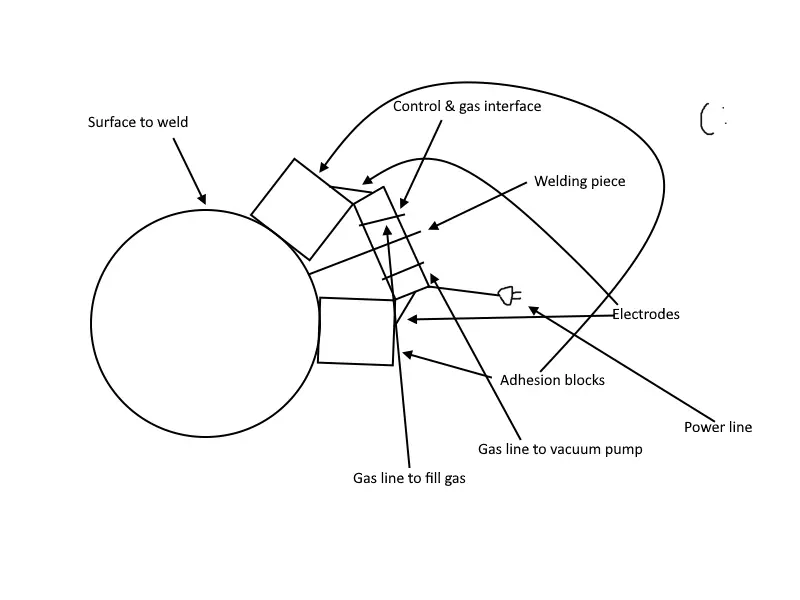
shitty diagram.webp


Here's also a nice video I first learned about electroadhesion from:
 
Ai-generated noise maker
Uh, no.

A noisy house would do zero against thieves, but would evoke ire and rage from otherwise law-abiding citizens, who would make it their mission to find our how to shove the device up your asshole in the least-comfortable way possible.

Want to be a noise machine? Move to Mexico or some other 3rd-world dump.
 
This isn’t a recent idea, but I have a distinct memory from when I was seven or so of talking my dad through an idea for modular housing, wherein the walls were on magnetic rails in the viewing and floor.
 
After learning about the sail rocket and the challenges it has to go through with reaching its top speed I thought about an equivalent that retracts its hydrofoil and takes flight instead of sailing. Here's a video showing one off in action. Also, negromancy has been committed to this thread.
 
A gun that shoots a bullet and plays a random song through a loudspeaker. And you can't make it shoot again until that song is over.

Alternatively, a gun that when you pull the trigger it plays a random song and shoots on every snare hit and you can't stop the song or the shooting so you just have to aim rhythmically.
 
Filtration/purification device that turns urine from livestock into usable DEF/AdBlue (diesel exhaust fluid) for running agricultural machinery.

DEF is a solution that is made out of 67.5% water and 32.5% urea, used in modern diesel-powered vehicles as a way to reduce harmful emissions. I'm not a chemist so I don't know if it's even possible, but I got the idea after reading how hog farms in the US use concrete slats for their floors in order to capture the waste products. Farmers already use manure for fertilizer, it'd be nice to have something for urine as well.
 
Filtration/purification device that turns urine from livestock into usable DEF/AdBlue (diesel exhaust fluid) for running agricultural machinery.
You'll probably get ammonia too from whatever refining process you use in that endeavor, since many kinds of microbes will actually degrade urea into ammonia and carbon dioxide. In that way you'll be able to use whatever ammonia you recover for fertilizer too.
 
VR headsets that mount to NVG shrouds.
You're oh so close. It isn't personal but I would prefer to give the solution to someone with 3D printing skills and that I can be 101% beyond a shadow of a doubt is not in Asia. The VR headsets are cheap but the NV is not. If it was though...
 
I'm gonna post an idea I've talked about a bit elsewhere on the forum here, I figured this thread could use more posts and this is a nice place to put it. The idea is just a kind of air filter to greatly reduce pollution in cities from cars and it should also help reduce bad smells and capture some microplastics(namely from tires breaking down on the road and the rubber on your shoes).
city air filter concept.webp
To go over the general idea of the design:
  • The porous wall/air input would readily suck up both car exhaust and also vape/cigarette smoke. It would also help to protect citizens from accidents if it's made out of something strong.
  • The mechanical filter servers the purpose of preventing larger debris from entering the harder to access parts(niggers will steal catalytic converters, so making it harder to steal is a must in any city) and clogging things up. It would also deter animals from walking into the UV chamber which would likely blind them.
  • The UV chamber will produce some ozone on its own and break down many compounds. Ozone is incredibly useful on its own. The UV light would also kill bacteria, fungi and viruses.
  • The ozone generator beyond that serves the purpose of producing a potent oxidizer, ozone, which is especially useful for the next step. They're pretty efficient at producing ozone.
  • The heated catalytic converter(CC) is very much like the ones in a car, but by making it larger and heating it beyond the point that your car's CC might get it will be better at breaking down compounds. The added ozone will readily react with the many hydrocarbon pollutants from car exhaust and when set properly it should make the outputs from that stage be largely CO2, water and N2. The reason for the heating is that chemical reactions, from what I've been informed, double in reaction rates every 10 degrees Celsius or so. Additionally the threshold for reactions are temperature based and although CCs reduce the threshold for those reactions to occur, heating the CC just servers to improve upon that.
  • The heat pump is meant to give the heat to the CC by recycling it from the outgoing air. It can't truly cool the outgoing air to be colder than it came entered the machine as this machine can not magically beat entropy. Instead it's just a measure to try and avoid wasting heat and to make the exhaust not as hot as it could otherwise be. Heat pumps are incredibly efficient for what they do.
  • The output being aimed up is to reduce the heat that city dwellers will experience. Hot air's tendency to rise will aid with this.
Now for the selling points:
  • When a nigger smokes weed the scent of skunky shit will quickly be consumed by the machine.
  • If an jeet walks by then the smell of curry and poo won't linger for as long.
  • Car exhaust is a major form of pollution and studies have found relations between exposure to air pollutants(including car exhaust but not exclusively them) and increased rates of various developmental disorders(including autism). Pollution, to my knowledge, has also been linked to increased risks for developing Schizophrenia and presumably other mental illnesses. Cities are hives of mentally ill people and pollution seems to be one part of that equation, so this device may very :optimistic: optimistically reduce the rates of mental illness in those shitholes.
  • Clean air is nice :).
  • You can get lobbying support from utility companies because this will be charged to the taxpayer(city """people""" aren't people so this is a good thing if it comes from their property taxes).
  • Adds new jobs.
  • Will make cities nicer and thus help to reduce the flow of city dwellers to suburbs :optimistic:.
  • Less mentally ill people means less trannies.
Now for the cons:
  • Without a good design these machines may be very noisy. Imagine a large AC unit on the street corner, as this will effectively have all of the parts of one plus some other bits thrown in(those parts don't make much noise).
  • Likely to be expensive.
  • Likely to be made to look ugly as sin.
  • Will make cities nicer and thus make city dwellers more smug.
  • Less mentally ill people means less trannies and lolcows to laugh at.
  • If the CCs don't degrade all of the ozone then this will contribute to producing smog and also make things smell bad.
 
I've been inspired to write about some macabre food production ideas I've had before and so I'll be double posting and committing necromancy. The summary of what these machines are is that they're cyborg food producers. One produces eggs, another produces milk and the final one regenerates flanks of meat to be cut off. All together they aren't even fed like typical livestock and instead produce their foodstuffs using electricity.
Now the go-to notion for lab grown meat these days, as well as other animal products, is to utilize the known technology of bioreactors. Now, to very quickly explain what a bioreactor is, one only needs to know that they're like more complex breweries and often they even utilize yeast like a brewery might. Here's a picture of a bioreactor:
tecnic-62-phone.webp
Bioreactors are great for many kinds of drug production from bacteria, yeast or other fungi. They've also been used for ages, especially if you consider the vats that brewers use as a type of bioreactor. The kind used for medical purposes though have been used for as long as citric acid fermentation has been done industrially by Pfizer. Here's a picture showing off a deep tank fermenter:
p167.png
The drawbacks for bioreactors are at least the following:
  • Contamination/Infection is always a possibility. Every input and output point carries the risk of foreign bacteria, fungi or protists to enter the system and proliferate and ruin the whole machine.
  • In the event of contamination or deployment a very intensive cleaning process needs to be undergone in order to remove any potential foreign contaminants.
  • All feedstocks must be sterile, increasing the cost to feed your organisms.
  • Maintaining pH and other parameters is far from easy and many require a steady release of media(the fluid it's all suspended in) that is considered spent whilst sterile, fresh media is introduced.
The drawbacks more specific for animal cells for meat production are the following:
  • Animal cells that you'd use to make meat naturally want to adhere to a surface. Bioreactors are amazing in terms of volume but lack extensively in surface area. This necessitates upping the surface area for animal cells to adhere and then a further step must be done to remove adhered cells from their substrate. Trypsin is usually used for this but it comes with risks and needs to be removed or else it'll kill cells. This requires a further washing step.
  • The media used to grow animal cells is eye-wateringly expensive. Some types of media can go for over 1k$ per liter.
  • Media is inefficiently used. Since media can not be filtered properly in a bioreactor and replenished that media must be continuously recycled to keep parameters at healthy levels for animal cells. This means that drip-feed system is necessary on a large scale and it drastically raises the costs.
  • Growing animal cells does not produce meat. Meat itself will require a further processing step to get the cells to form into muscle tissue.
This all makes growing meat in bioreactors into a very costly venture and why you'll see headlines saying lab grown steaks would cost hundreds of thousands of dollars. For growing things like certain proteins or hormones though, bioreactors are great. They're already used for this as well. However milk and eggs are more complex than just some proteins and fats and to take the harvested product of a bioreactor you need to go through quite a bit of processing to separate it from any of your organisms and the media it was grown in. This means synthetic milk and eggs will be very highly processed.

Alternatively we could avoid having to do a great deal of processing all together for our products if we instead create cyborg animals. It'd also be really cool :). The idea is simple, you take a farm animal and then you employ some surgeries to remove most of the brain of the animal and hook it up to your machine. The drawbacks are with initial cost and you'd want to use genetically modified animals that will live very long lives or else this will be far less profitable. You'll also want them to be more resistant to forming cancer(s). The pros of this approach are the following:
  • Contamination becomes a non-issue. The immune system of the animal is fully intact and able to fight off any foreign microbes.
  • Due to contamination not being an issue it's far easier and cheaper to feed and handle the machine(s).
  • No expensive media to keep the cells happy, the organs of the animals themselves maintain their own media(blood & lymphatic fluid) and separate out waste products.
  • You can get whole eggs and milk without the need to process them.
  • In the case of eggs you can separate out the oviduct(where the eggs come out) from the cloaca so you don't have poopy eggs but can still get a protective protein coating on them.
  • Compared to traditionally livestock these units are less likely to be infected by diseases as their chassis and immobile nature shrinks the window for infections to spread.
  • The flesh is weak.
The cons are the following:
  • These machines will require quite a bit of investment per unit. The surgery is going to need a skilled worker to perform.
  • The genetically modified livestock requires a major investment cost in the form of R&D.
  • The machine is far more vulnerable to failure. In the event that a bioreactor's culture fails or is contaminated it's far easier to restart a culture than it is to revive a dead chicken or cow.
  • Vegans will screech their heads off and so the market of trying to sell to them(lol, they wouldn't eat lab grown meat either by the way because they're just mentally ill, narcissistic faggots who need to feel special) is lost.
  • Will upset pathologically empathetic people.
  • Bulky and hard to move compared to traditional livestock. All movement has to be performed by machines as you can't corral and guide them.
  • Significant R&D will need to be done on implementing sensors for reading biometric data to keep the machines healthy.
Now, the manufacture of these machines starts with a genetically modified livestock animal. In the case of the egg machine this would be a chicken and a dairy cow in the case of the milk machine. The meat machine would require the most work and the processes of regeneration that something like a hydra or axolotl can carry out is not entirely understood and so for that it's all theoretical with gaps in the know-how to do it. For my variant of cyborg livestock though a few key features are necessary. They are:
  • Electrosynthetic tissue/organ that utilizes the Calvin cycle.
  • Malate formation in the lungs/respiratory tissue and utilization.
  • Enzymes to digest and break down micro/nano-plastics.
  • Removal of the non-excretory portions of the brain.
Now I'll go ahead and explain each point and how they can be done/why they're there.
So to start off, we'll cover the electrosynthetic tissue/organ. Now, this is likely to be news to many people reading this but many kinds of bacteria can actually derive their chemical energy from electrical potentials. They're commonly called "electric bacteria" and they derive their energy in a few ways, but often they even have biological wires. Here's an infographic to help explain two of the ways they derive their energy:
ElectrictyEaters_615.png
While this may seem strange, it's actually not that bizarre when one understands that the driving force for ATP synthesis is itself a matter of charge separation between the inside of the cell and its environment. The idea about the electrosynthetic tissue is to rely upon stolen genes from some of these electric microbes in order to drive ATP synthesis in tissue that binds to electrodes. The cells on these electrodes then utilize the Calvin cycle, the process in which plants produce their sugars from a carbon source, like carbon dioxide, to then make sugars for our animal. In this way our cyborg animals can derive their energy from an outlet and the air.

It would be ideal to make a specialized organ in our genetically modified animals that are to be cyborgified, however an alternative is to make tissue cultures from the species involved that are invisible to the immune system and that can be easily cultured. This way they can instead be "plugged in", for lack of a better term, to our stroggified critters and give them their sugary needs.
Now the Calvin cycle largely uses carbon dioxide, but this is only the case with some photosynthesizers. There exist other forms of photosynthesis, in fact more efficient ones, that instead convert CO2 into malate for storage and then back in to CO2 when and where necessary. Namely CAM photosynthesis and C4 photosynthesis both utilize malate in this way. Here's a diagram showing off the various forms of photosynthesis:
maxresdefault (2).jpg
Malate is so important because it is far more easily stored in cells and for C4 and CAM photosynthesis it is used to make a CO2 rich environment around the RuBisCO enzyme to avoid the toxic reaction of it with O2, which is costly to fix and of course does not produce sugars. This means that having our respiratory tissue having the pathway to form malate can take CO2 directly out of the air which can then be transported to the electrosynthetic tissues/organ by their blood to form sugars later. Likewise any CO2 looking to escape the body can instead be transformed there to prevent it from leaving.
This one is rather simple to explain and to justify. Plastics are everywhere and a major problem and cause all kinds of issues, many of which we're only now becoming more aware of. However there are already microbes and fungi that have adapted enzymes that they have to digest plastics. By giving our cyborg animals these enzymes we can make sure that this step in our food production produces plastic free products and that the animals will be able to live marginally longer lives, making for better long-term profits.
The brain is largely not necessary for our cyborg animals and even worse impedes its functions. The machines can ideally take over all of the autonomous roles that the brain could otherwise perform, but without all of that flailing around or screaming. The excretory portions of the brain though, like the pituitary gland and hypothalamus are absolutely necessary for the endocrine(hormone) system to function. Thus they and the brain stem should remain. The brain stem can handle the steady beat of the heart and the pumping of the lungs and feedback information to the glands whilst they keep hormones flowing properly.

As for the meat producing cyborgs, they'd be far less machine than the milk or egg machines. Namely because they'd largely be de-brained but retain a greater regenerative ability. The idea being that you can cut portions of these brain-dead critters off and have them regrow the tissue like an axolotl can.
 
i just saw a youtube short about a kid's toy called "phonorgan" which was a toy synth with a built-in 45rpm record player. all it does is let you play music along with the music it's playing but i had a better idea...

what if instead there was a mechanism that lifted the needle and yanked it over to a certain position on the record when you pressed a key? obviously this would almost certainly kill any normal 45rpm record that was used with it but if there were specially designed records that were more durable and held samples (or really anything) then you could get a really cool analog soundboard-synth-style musical instrument out of it.

i'd really like to see someone make this i think it would be fucking dope.

maybe it could be named "synthogram" "synthograph" or "edison magnificent interchangeable spinning disk keyboard" or something
 
Back
Top Bottom