Election results
465 seats in the House of Representatives
233 seats needed for a majority
| Party Leader | Party | Spectrum Affiliation | Seats Won (Before) | % of Seats | Total % by Spectrum Affiliation |
|---|
| Sanae Takaichi | Liberal Democratic Party (LDP) | Right-wing | 316 (196) | 68% | 79% |
| Toshihiko Noda/Tetsuo Saito | Centrist Reform (Komeito) | Centrist (with cult affiliations) | 49 (167) | 11% | 19% |
| Hirofumi Yoshimura/Fumitake Fujita | Ishin (Restoration Party) | Right-wing | 36 (34) | 8% | 79% |
| Yuichiro Tamaki | DPP | Centrist | 28 (27) | 6% | 19% |
| Sohei Kamiya | Sanseito | Right-wing | 15 (2) | 3% | 79% |
| Takahiro Anno | Team Mirai (Team Future) | Centrist (Technocratic) | 11 (0) | 2% | 19% |
| Tomoko Tamura | Communist Party | Left-wing | 4 (8 ) | 1% | 1% |
| Kazuhiro Haraguchi/Takashi Kawamura | Tax Cuts | Centrist | 1 (5) | 0% | 19% |
| Taro Yamamoto | Reiwa | Left-wing | 1 (8 ) | 0% | 1% |
| Independents | - | - | 4 (10) | 1% | 1% |
Election map
It was a bloodbath landslide. Takaichi and the LDP won enough seats to create a supermajority in the House of Representatives of the Japanese Diet (even seizing the entire metropolis of Tokyo). Right-wing rival parties such as Ishin (which only won their homebase of Osaka), Sanseito, and the Conservative Party of Japan (which won no seats) could not make a dent in gains of the LDP. Ultimately, it proves that Takaichi's popularity won out in the long end against Sanseito's attempts to tell voters that they are on Takaichi's sides and the CPJ's attempts to break trust in the LDP. Centrists (Centrist Reform) were annihilated to irrelevancy. Left-wing parties had no chance.

What happens now?
Obvious
The right-wing bloc (LDP, Ishin, and Sanseito) has control of almost 80% of the Diet's Lower House--the House of Representatives. As the right-wing bloc are all supportive of restoring Japan's wartime capabilities, they would have more than enough in the lower house (2/3 - 66%) to launch a motion to amend Article 9 of the Constitution, which limits Japan's military capabilities and prevents them from having a standing military. Nevertheless, they do not have effective control over the Diet's Upper House, the House of Councilors, where they only have a slim majority (54%) and thus do not have the 2/3s majority to pass it to then push the motion to change Article 9 to then be decided by referendum. The next House of Councilors election is in 2028.
Nevertheless, assuming the right-wing bloc is united (even with Sanseito), they can pass any motion into law without any interference from the House of Councilors due to the fact they have a supermajority in the House of Representatives. The Constitution gives the Lower House more power than the Upper House as well as the veto option, giving the right-wing bloc the ability to pass anything they want into law that is not amending the Constitution.
Least Obvious
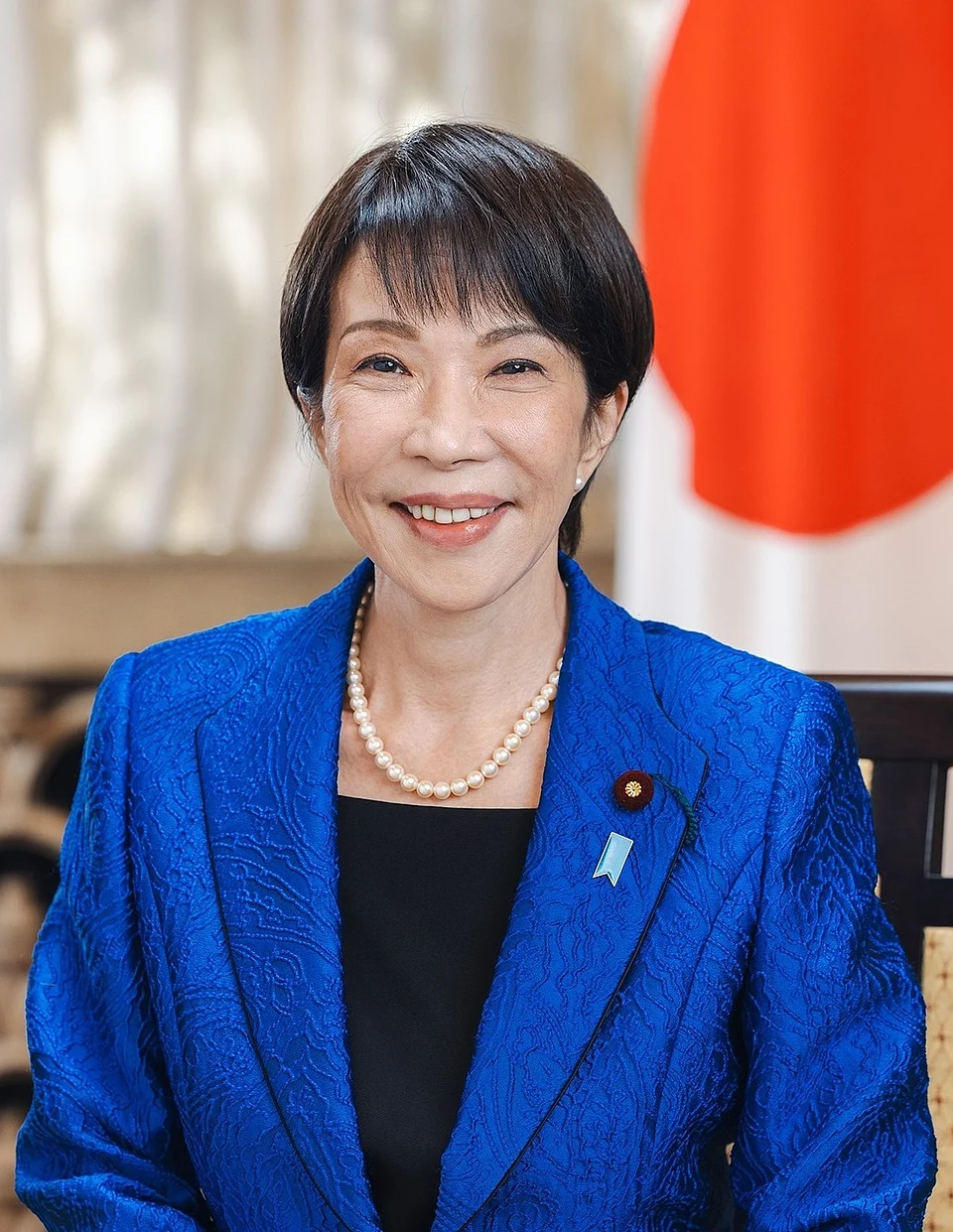
|

|
Sanae Takaichi, Prime Minister of Japan | Kimi Onoda, the Hapa Minister in charge of a Society of Well-Ordered and Harmonious Coexistence with Foreign Nationals (in addition to Minister of State for Economic Security) |
The unity of the right-wing bloc and thus its ability to enforce Japanese immigration laws and launch mass deportations depend on the LDP. It was the LDP under more globalist politicians such as Fumio Kishida and Shigeru Ishiba that launched programs to mass import labor from India, Africa, China, South Korea, Vietnam, the Philippines, and the Muslim world that harmed the social fabric in Japan due to their refusal to assimilate and instead take advantage of Japan's social system. Numerous scandals has affected the LDP such as its connections to the Unification Church cult and has revealed numerous factions within the LDP that are competing for power. Now the power rests on Prime Minister Sanae Takaichi, a protege of Shinzo Abe, the most famed prime minister of the LDP and of Japan.
Takaichi has indicated that she will resign if the LDP does not gain a majority, so it is most likely an agreement that she has with other leaders of the LDP to place all their bets on being anti-immigration for the party to succeed. Thanks to close ally and minister Kimi Onoda and her clarifications on anti-immigration policy, Takachi has won a supermajority, increasing her influence and power within the LDP and more likely to bend the party to what she wants. However, that is the issue on hand.
If you remember the
primaries debate between Takaichi and other establishment LDP politicians by creator of 2channel and owner of 4chan Hiroyuki Nishimura, Takaichi after winning the leadership of the LDP and thus becoming Prime Minister, had all those politicians be a part of her cabinet: Hayashi, Koizumi, Motegi etc. Takaichi in the debate also comments on wanting stronger ties with India and Africa (which is either a bad sign for more migration or trying to compete with China on global influence, or both). Takaichi promises a crackdown on illegal immigration but is unsteady on the issues of legal migrants within Japan in the debate, and
Kimi's speech on that issue has caused a shake of trust that luckily did not affect the election outcome.
It is of the position of the LDP and most likely Takaichi that industries in Japan has a shortage of labor and that they need to import foreign labor to fix that shortage, even though that position is extremely unpopular in Japan. The summary of Takaichi's position from what she and Onoda preaches is this: Japan will
- crack down on illegal immigration, making Japan illegal-migrant free
- strengthen naturalization and permanent resident processes and make it difficult for foreigners to become Japanese citizens
- keep legal migrants in Japan in the "Skilled Workers" program as a temporary measure to fix labor shortages but they
- cannot bring their families
- are in Japan on a time limit
- will be heavily reviewed if they can be permanent residents or not
- there will be 1.23 million foreign laborers in Japan to fix the labor shortage, including those that are in Japan right now
- make sure foreign laborers do not abuse Japanese benefits
- crack down on over-tourism and abuses by tourists (such as the limits of tourists in Kyoto)
- if foreigners fail to abide to these rules and do not properly embrace a Japanese lifestyle, they will be deported
This is the most moderate policies that Takaichi and the LDP promise to implement. Compared to more radical parties such as Sanseito and the Conservative Japan with kicking out all the foreign laborers, for Japanese normies, this seems to make the most sense. Ultimately, these are just promises. If Takaichi fulfills them, she could be Japan's most popular prime minister in an instant just by fixing this one issue. Takaichi could however just not implement these policies and keep importing labor because we know that foreign labor is basically a drug to the LDP, especially as it pertains to its establishment globalist factions, and Takaichi may have as well be a member of these factions.
If Takaichi and the LDP fail to address the foreigner issue, then Japan may face another long doomer session of migrant issues, harassments, and rapes until the next election, where Sanseito eats away their votebase. In Italy, voters elected Giorgia Meloni and right-wing parties to become Prime Minister and the ruling government respectively to crack down on illegal Muslim migration into the country from Tunisia and the Middle East. Meloni has proven extremely incompetent and inept in her handling of the nation's migration issues and did not crack down migrant gangs and illegal migrants and sending them into prisons and instead having to beg foreign nations to take their migrants back. Recently,
3 migrants surrounded an Italian couple, broke into their car, and forced the boyfriend to watch as they rape his girlfriend. Meloni did NOTHING.
Takaichi and the LDP has two choices here.
I would note that the birth rate crisis is not really that bad in Japan (in fact, Japan is in a way better state than South Korea and Taiwan) due to the culture of women becoming housewives and starting families, so Japan is likely to have a stable native population growth after a decline. However, I did hear of a policy that was instituted by the LDP probably under Shinzo Abe where women are given financial aid from the state to become housewives and that policy was almost rid of by more globalist LDP politicians like Shigeru. The only disadvantage of being a housewife is Japan is the lack of socializing, and thus why I saw a trend in Japanese social media of housewife vlogs so that housewives are able to socialize with each other, remedying the situation.


