I have way too many knives. Both kitchen and otherwise. I feel the need to effort post. I'm not a collector in the classic sense I don't need to own every knife of a series or manufacturer it's more that I want to fill every niche.
The chefs knife

Jack of all trades master of none. You have two choices basically: european or or japanes (santoku) which funnily enough is based on french/german chefs knives. This is the one knife you must have. Without it you cannot cook effieciently. If you get a cheap one it will be good enough and if you get an expensive one you will never know how good you have it. If you are only going to get one get the european style. It can do things the santoku can not. If you get a proper one whose blade is tapered from handle to tip and from spine to edge it can act like a much smaller blade. A santoku can't because the tip is steeply rounded.
A european style chefs knife has a thick heavy spine and a generally thicker blade. You can cleave with it, you can slice and you can chop with it. It will not be the best of any of those things but it can do all of them. Since it is thick you can beat it up, you can drop it and you can use it as a cleaver.
Santoku

A santoku is a much better slicer since it has a thinner spine and usually a less steep edge angle. Since most cooking is slicing and dicing a santoku has a lot of use. I will tend to use the european knife for cutting meat and heavier cutting but the santoku saw the most use when I had both.
The differences between an expensive knife and a cheap knife will be that the expensive knife will have perfect balance, a pronounced taper from handle to point. The blade will be thicker towards the spine and taper to almost nothing by the edge. This allows you to slice an onion effortlessly with the forward portion of the blade while still having the strength to part a chicken closer to the handle. It will also be forged which will make it stronger. A cheaper knife will have almost the same thickness through the length of the blade both crosswise and length wise. It will usually arrive dull and with a steep edge angle and require sharpening out of the box.
Cheap punched knife:
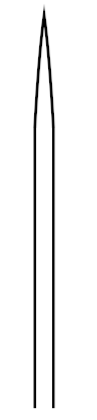
Expensive forged knife:
 Paring knife

I would say this is a must have. This is the knife you will reach for most often every day. It can be used to open mail, boxes, peel anything you need to peel, cut around bad parts of vegetables, get brought to the table to cut salami or cheese. Those times you need slice just one tomato for a sandwich. If you're getting a proper forged one it will cost about half as much as your forged chefs knife. It's probably worth it. A cheap punched one will have too thick of a blade and will get bent if you happen to pry something with it.
Serrated knife/bread knife

This is the last must have. If you intend to slice most types of bread you need to have a serrated knife. A cheap one is probably not worth getting. Get at least a middle of the line one. An expensive one will not really be much better than a decent one. It will be prettier and have a better balance.
The slicer
A knife with an extremely thin blade and probably from Japan. This knife has an a very shallow angle maybe as low as ten degrees on one edge. If you hit bone or sand/dirt you will knick the edge. If you use it to smash garlic you will worry you might snap the blade. Thanks to its thin spine and shallow edge angle it will slice through vegetables with ease. It is very nice to have and if you have one you will probably spend more time with it than your chefs knife.
Chinese chefs knife/vegetable cleaver

Probably nice to have. I just aquired one and have been forcing myself to use it for everything to get used to it. I got it because my second most recent acquisition is a carbon steel slicer which absolutely sucks to pick up food with and the great big spade of a chinese clever is the oposite. It can do a few things the other knives can't. It can pick up great gobs of vegetables from the cutting board, the high blade can reach over large foods so you can push on the spine to help with the cut, because it has a long straight blade you have unparalleled angle control so it's easy to cut straight and thin, since it's large, flat and heavy it's extremely easy to smash garlic with it. It is growing on me but it has drawbacks. You can not use your forefinger over the spine to peel away a slice of something you want keep gathered or to press something together. There are ways around this but still. It feels like the weight of it makes it easier to cut gnarly things like ginger or carrots with ease. It is heavy and tiring to use compared to other knives. I think that might be a matter of technique where I should be resting it on the board rather than keeping it in the air like a normal knife.
Carbon vs. Stainless
I started with stainless because it is just objectively better and requires less care than carbon steel. But I have always preferred carbon steel for sharpening. For me I get shitty carbon steal much sharper much easier than expensive stainless.
My last three kitchen knives have been carbon steel and they are really growing on me. The patina they get from the acids in the food is beautiful and they take an edge like nothing else. Just a few strokes on a ceramic honing rod and they will shave your arm. But leave them dirty for half an hour and they will rust on you. You have to dry them religiously before putting them in the block and probably oil them from time to time. A stainless steel knife will just start to look scuffed with use. A carbon steel knife will start to aquire soul.

For sharpening I use a ceramic honing rod from IKEA. I stroke the knife five to ten times when taking it out and sometimes when putting it back in the block. When the knife stops cutting tomato even though I honed it I will use a cheap diamond honing rod also from IKEA for a few minutes and then back to the ceramic. Every year or so I need to hit a bench stone to reprofile the edge.
Sharpening is hard to learn. It looks easy when you know how but it is hard. It takes experience. I've been having a go at it since I was about twelve and I'm now in my middle ages and I finally am starting to feel I'm getting decent at it. Just get a knife that is dull enough to be useless and try to get it useful again. There are plenty of videos on youtube on how to sharpen. Outdoor55 probably taught me the most. He knows his stuff. Unfortunately I am old enough to have spent the first ten or so years sharpening without youtube even existing and no one to learn from.


