Ham Radio / Off-grid communication

I haven't used that program before, but is it this one? https://github.com/luamfb/tempest-lcd

View attachment 8785692

"Tempest for Eliza" is a program written by Erik Thiele to demonstrate the RF transmission properties of CRT monitors. The program is capable of transmitting sound over AM frequencies just by the unique way it drives the monitor. The electromagnetic emissions of CRTs can be a security problem as demonstrated by Van Eck phreaking, watching someone’s screen just by collecting RF transmissions. In the late ’90s Ross Anderson developed software to help reduce the RF transmissions of monitors. These specialized fonts combined with shielding can greatly reduce the risk of attack and is something the NSA has been researching for many years."


The project/name is familiar, (I believe it's a fork to allow for LCD support?) I've had luck in using Tempest for Eliza with an LCD hitting both AM and FM. So IDK whether there's a real difference between the two projects.

Thanks for the reply+info! :)

If you should try Tempest for Eliza, you'll note it comes with a few files which play as simple beeps in your radio while your screen is changed for each note. Crude theme song(s) and jingles for examples.

I've seen videos years ago where people had managed to get it to play MP3s which would be very useful! (and not simply for playing music) I'd like to know how, too! :) Maybe one day. . .
 
Last edited:
I've been into ham on and off for years now. What's a good radio that can connect me to everyone within a 50 mile radius with buildings and trees between us regardless of atmospheric conditions? I think I looked into 40m a while back but it seemed like it had a minimum range that would exclude everyone within 20 miles.
 
I've been into ham on and off for years now. What's a good radio that can connect me to everyone within a 50 mile radius with buildings and trees between us regardless of atmospheric conditions?
What you are looking for is NVIS (Near Vertical Incidence Skywave)

1775245602449.png

NVIS is a type of propagation characteristic that enables 0 to 300 mile regional communication regardless of line of sight, terrain, obstacles, and has a more stable channel versus regular HF communications.

I think I looked into 40m a while back but it seemed like it had a minimum range that would exclude everyone within 20 miles.
This is called the skip zone. In traditional HF propagation, there is an area that is out of reach of your signal. It's too far for groundwave but too close for skywave to come back down.

1775245796750.png

When we are operating NVIS we eliminate the skip zone entirely. What makes a signal follow NVIS propagation is the antenna and frequency selection.

80, 60, and 40 meters are generally the bands used in mid-latitudes. The frequency that determines NVIS prop is called the fof2, or critical frequency of the F2 layer of the ionosphere
1775246262624.png

In hte map above you can see the regions shaded with different colors which correspond to their critical frequency based on ionosonde data.

Daytime operation is usually 40 meters while nighttime the FoF2 drops down closer to 80m. A 40/80 dipole low to the ground at a horizontal angle is one of the best antennas for NVIS. Compared to regular prop, a NVIS antenna can be as low as 3 ft to the ground and still make a successful contact.


Antennas for NVIS prop are extremely simple. It can literally just be two wires cut to length dragged across the ground . The only drawback is the relatively large antenna footprint which requires between 20 to 100 ft of horizontal space. But there are many compromise antennas with good horizontal takeoff angles that are even more compact.

Any HF rig that can do 80/60/40 is a good choice, and even something like the truSDX will work for NVIS SSB and data comms.
 

Attachments

Last edited:
As an alternative to NVIS, you can make a vertical for the 160m band and use ground wave propagation.

Obviously a 1/4 wave vertical on 160m is pretty colossal, but you can load at an antenna at 30-40ft tall, or out up as large an inverted L as you can, then chuck out a radial field of cheap speaker wire if you have some room.

If you are in a region of middling to good ground conductivity, everyone in a few hundred miles will hear you if they are also on verticals or inverted Ls.

 
As an alternative to NVIS, you can make a vertical for the 160m band and use ground wave propagation.

Obviously a 1/4 wave vertical on 160m is pretty colossal, but you can load at an antenna at 30-40ft tall, or out up as large an inverted L as you can, then chuck out a radial field of cheap speaker wire if you have some room.

If you are in a region of middling to good ground conductivity, everyone in a few hundred miles will hear you if they are also on verticals or inverted Ls.

You can but this is very impractical. There are few if any advantages to this over NVIS operations. The only exception I can think of is if you are operating in the daylight side of the earth during a complete radio blackout, but the antenna footprint is simply too large for any practical consideration even with a quarter wave vertical.

NVIS works during disturbed conditions albeit very poorly. There is a paper that models channel parameters during solar X-flares on daytime communications. There are high absorption losses but not to the point where it is totally unusable.

I would bet, though I could be retarded, that something like JS8call or at the very minimum CW would still be usable even during severe solar activity. The NVIS channel doesn't behave the same way the traditional HF channel does.

If there are any obstructions in the way of a ground wave path your SNR decreases dramatically. Groundwave is largely dependent on the site of the transmitter and receiver which sometimes can be an unknown, depending on who you want to talk to.

1775689401040.png

NVIS can work from the bottom of a valley. The best way to think of it is like pointing a lawn sprinkler straight up above you.
1775689594129.png

The received power at any point in the radius is near uniform.

Compromise antennas (antennas that are electrically, but not physically) resonant on the bands play super nice with NVIS because of the lower power requirements compared to traditional HF prop.
1775689457487.png

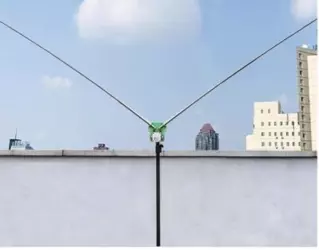
This is a "DP-200" antenna that has a 40 meter extension coil that I work NVIS with. 35 watts out of it can get me doing super fragile data modes out to 250 km.

A half-wave dipole for 40/80 like in the vid I linked above slung just a little above the ground can work NVIS.


Ground wave signals are also ridiculously easy to direction find with near pinpoint accuracy with the most barebones equipment.

A very "famous" antenna for NVIS is the AS-2259. It's designed in such a way to eliminate the groundwave component to prevent ground based direction findiing.
1775691070537.png


It's a myth that NVIS signals are immune to ground-based direction finding, but it takes much more effort and much more sampling than just getting a bearing immediately which is possible with any signal that has a groundwave component. It's also very susepctible to air based direction finding.

(See: https://patentimages.storage.googleapis.com/52/8c/c2/a51de6f454d67f/US11550021.pdf, this is the mechanism employed by ground based DF equipment to locate NVIS signals. tldr is sampling the angle of incidence at different times)
1775691290282.png
 

Attachments

Even with a very shortened antenna, it is still quite effective, I have a 160m mobile hamstick that must be single digits of efficiency and was still able to make contacts in the range mentioned. Something like a tarheel with a longer whip is a bit better.

Even full size, a 160m inverted L, say 30 feet up and 100feet across is no bigger than a 80m dipole. Cutting it down to 70-80ft still works OK and is far easier to accommodate than the dipole, add an antenna tuner it will do 6-160 with ground wave and NVIS as it radiates in both polarisations.

https://vk6ysf.com/inverted_L_hf_portable.html

Another alternative is to run a doublet antenna, an 80m doublet will also tune 6-80, and when shorted together at the bottom will function as a top loaded T antenna vertical.
 
Not Flux, but there's also the (somewhat unused admittedly) other FLDigi modes like PSK31, Olivia, etc. that are keyboard-to-keyboard. These IIRC have lower sensitivity than JS8Call but still can work serviceably for chat needs if the signal is strong enough.
The SCAMP modes recently added to FLDigi do pretty well with weak signals, and they were originally built to work on microcontrollers and not need huge CPU power like FT8/JS8Call does. The RFBitBanger kit radio has those built-in and you can just plug a PS/2 keyboard into it and use it for SCAMP, RTTY, CW, etc.

I read the paper Daniel Marks published about it and it's kind of neat how they fit 2 characters into each code word.
 
The SCAMP modes recently added to FLDigi do pretty well with weak signals, and they were originally built to work on microcontrollers and not need huge CPU power like FT8/JS8Call does. The RFBitBanger kit radio has those built-in and you can just plug a PS/2 keyboard into it and use it for SCAMP, RTTY, CW, etc.

I read the paper Daniel Marks published about it and it's kind of neat how they fit 2 characters into each code word.
This is incredibly interesting, I really like the projects goal of using as generic components as possible

Also just found this implementation of it https://github.com/alberto-grl/SCAMP_TERM

Wish I had heard about this sooner. Amazing project!!!!
 
I'm looking for recommendations for a radio that does ham bands and as many other bands as possible like CB, licensed VHF, marine, FRS etc. Another idea for a project I've had is transforming my old car into a james bond car so the radio would be useful for that goal.
 
I'm looking for recommendations for a radio that does ham bands and as many other bands as possible like CB, licensed VHF, marine, FRS etc. Another idea for a project I've had is transforming my old car into a james bond car so the radio would be useful for that goal.
A single radio that does all those things will be pretty difficult. One of the wunderwaffen mobiles gets closeish. They do usually make FRS and sometimes CB TX pretty hard because yeah, everyone wants that. Even if possible, you better be at least passable at SMD soldering. Receive is just a couple SDRs but I doubt that's what you want.

You're probably better off biting the bullet and remote mounting multiple radios because 1: you're going to need a bunch of antennas anyway and 2: when it comes right down to it even those all in ones are three or four completely separate radios inside with one UI.
 
A single radio that does all those things will be pretty difficult. One of the wunderwaffen mobiles gets closeish. They do usually make FRS and sometimes CB TX pretty hard because yeah, everyone wants that. Even if possible, you better be at least passable at SMD soldering. Receive is just a couple SDRs but I doubt that's what you want.

You're probably better off biting the bullet and remote mounting multiple radios because 1: you're going to need a bunch of antennas anyway and 2: when it comes right down to it even those all in ones are three or four completely separate radios inside with one UI.
What about a transmitter to interfere with weather radios? I don't suppose there's a sketchy company to make one.
 
What about a transmitter to interfere with weather radios? I don't suppose there's a sketchy company to make one.
That's just a Baofeng...

I'm looking for recommendations for a radio that does ham bands and as many other bands as possible like CB, licensed VHF, marine, FRS etc.
Maybe an Icom 7100 or Yaesu 991A, MARS modded in either case. I wouldn't expect good performance outside of the ham bands, but it might work well enough in a pinch.

There's still the point about antennas. CB's probably the easy one with a tuner.
 
I'm looking for recommendations for a radio that does ham bands and as many other bands as possible like CB, licensed VHF, marine, FRS etc. Another idea for a project I've had is transforming my old car into a james bond car so the radio would be useful for that goal.
Real quick.
Do you mean transmitting on all these frequencies or just receiving?

With the WR-12 add on, the X6200 can receive all those assuming you have a long wire antenna, but it only transmits HF bands.
 
Cool vid on modding a cheap $50 chinesium "AT-14" antenna switch to work over WiFi with an ESP32

I'm looking for recommendations for a radio that does ham bands and as many other bands as possible like CB, licensed VHF, marine, FRS etc. Another idea for a project I've had is transforming my old car into a james bond car so the radio would be useful for that goal.
Transmit or receive? If you want reception, a RTL-SDR v4 will cover all of those. The IC-7100 can do all mode but again as others have said, you'll need seperate antennas for working seperate bands.

What about a transmitter to interfere with weather radios? I don't suppose there's a sketchy company to make one.
:stress:What?

There's really only a few things that will get you in hot water with the FCC. You can literally do whatever so long as it's:

A: not playing commercial music
and B: not fucking with public safety frequencies

That's by far the most retarded thing I've read in this entire thread, so congrats. I hope you can clarify what you mean.
 
....why the fuck would you even vaguely want to do that?
There's really only a few things that will get you in hot water with the FCC. You can literally do whatever so long as it's:

A: not playing commercial music
and B: not fucking with public safety frequencies

That's by far the most retarded thing I've read in this entire thread, so congrats. I hope you can clarify what you mean.
To warn people of a category 5 chimpout
Transmit or receive? If you want reception, a RTL-SDR v4 will cover all of those. The IC-7100 can do all mode but again as others have said, you'll need seperate antennas for working seperate bands.
To transmit to and receive different two way frequencies.
 
Back
Top Bottom