As an alternative to NVIS, you can make a vertical for the 160m band and use ground wave propagation.
Obviously a 1/4 wave vertical on 160m is pretty colossal, but you can load at an antenna at 30-40ft tall, or out up as large an inverted L as you can, then chuck out a radial field of cheap speaker wire if you have some room.
If you are in a region of middling to good ground conductivity, everyone in a few hundred miles will hear you if they are also on verticals or inverted Ls.
You can but this is very impractical. There are few if any advantages to this over NVIS operations. The only exception I can think of is if you are operating in the daylight side of the earth during a complete radio blackout, but the antenna footprint is simply too large for any practical consideration even with a quarter wave vertical.
NVIS works during disturbed conditions albeit very poorly. There is a paper that models channel parameters during solar X-flares on daytime communications. There are high absorption losses but not to the point where it is totally unusable.
I would bet, though I could be retarded, that something like JS8call or at the very minimum CW would still be usable even during severe solar activity. The NVIS channel doesn't behave the same way the traditional HF channel does.
If there are any obstructions in the way of a ground wave path your SNR decreases dramatically. Groundwave is largely dependent on the site of the transmitter and receiver which sometimes can be an unknown, depending on who you want to talk to.

NVIS can work from the bottom of a valley. The best way to think of it is like pointing a lawn sprinkler straight up above you.

The received power at any point in the radius is near uniform.
Compromise antennas (antennas that are electrically, but not physically) resonant on the bands play super nice with NVIS because of the lower power requirements compared to traditional HF prop.
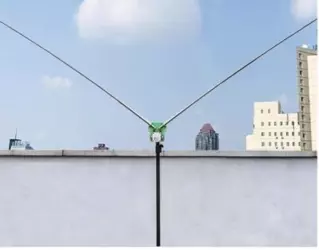
This is a "DP-200" antenna that has a 40 meter extension coil that I work NVIS with. 35 watts out of it can get me doing super fragile data modes out to 250 km.
A half-wave dipole for 40/80 like in the vid I linked above slung just a little above the ground can work NVIS.
Ground wave signals are also ridiculously easy to direction find with near pinpoint accuracy with the most barebones equipment.
A very "famous" antenna for NVIS is the
AS-2259. It's designed in such a way to eliminate the groundwave component to prevent ground based direction findiing.

It's a myth that NVIS signals are immune to ground-based direction finding, but it takes much more effort and much more sampling than just getting a bearing immediately which is possible with any signal that has a groundwave component. It's also very susepctible to air based direction finding.
(See:
https://patentimages.storage.googleapis.com/52/8c/c2/a51de6f454d67f/US11550021.pdf, this is the mechanism employed by ground based DF equipment to locate NVIS signals. tldr is sampling the angle of incidence at different times)


 What?
What?