I swear I remember reading someplace that the Pitt DLC was a response to people who wanted more morally-gray choices and characters than what was in the base game. But it wasn’t the black-and-white morality that made the game’s story mediocre, it was the writers themselves who weren’t very good, regardless of what kind of story they were trying to write. Thus the attempt at being “morally-gray” still ended up being just as contrived as the “good guy vs. bad guy” base game. They were just like “let’s write about obviously good things conflicting with obviously evil things! That’s what moral ambiguity is, right?”
I've heard that too.
I think they're generally stymied in trying to portray something controversial that could be approached with nuance depending on the situation, especially something like slavery. Considering how many retards there are out there, they feel the need to beat the player over the head with, "Slavery is bad! We don't agree with slavery at all! It's unjustifiable, complete unjustifiable! We really, really, really don't, not in the slightest, support slavery. But..."
They really heap on how absurdly shit and pointless an existence the slaves live. Even after you liberate them they're still working like slaves because...
It pushes you to wanting to help the slaves so much and let you the player know that it's a rotten practice that the Asher and baby stuff at the very end is far too abrupt in how it's introduced. You are never told or so much as hinted about what the true nature of the "cure", or the fact said "cure" isn't even a "cure" at all in a literal sense, but a symbolic hope of a cure in the future. You're not allowed to push Werner on the details, or get shut down in the process and I think out of the core group of plotters he's the only one who knows. It's perfectly functionable as a twist but it comes out at the last 10% of the DLC and like most Bethesda things you're stick in a binary with how you can handle it, and when set in the context of how Bethesda typically does these things, it's unusual there's no "golden ending" for this. It's either: keep the status quo with brutal slavery but a family kept whole, or end slavery but (possibly) subject a baby to callous experiments after killing both its parents and essentially receive the same vague timeframe as to when a cure will be found as you do from Asher and his wife.
The only other instance of this I can recall in 3 is the Ghoul and Tenpenny Tower situation, where there's effectively no "good" ending unless you don't involve yourself at all.
Unless you consider slaughtering the ghouls the good ending, in which case I largely agree, but killing them before the crime means you're killing mostly innocents so it's Schrodinger's moral dilemma. Arbitrary black and white approaches are usually all you get, usually with a choice to make the good choice even
gooder or the bad choice even
badder. You don't even get the option to tell Ashur to pack it in a bit, or have his men cool their jets a little; though I suppose that presents another possible criticism in the same way "kill yourself" to Eden was, in that it seems like you're getting way too much bang for your buck in what you could possibly convince someone to do.
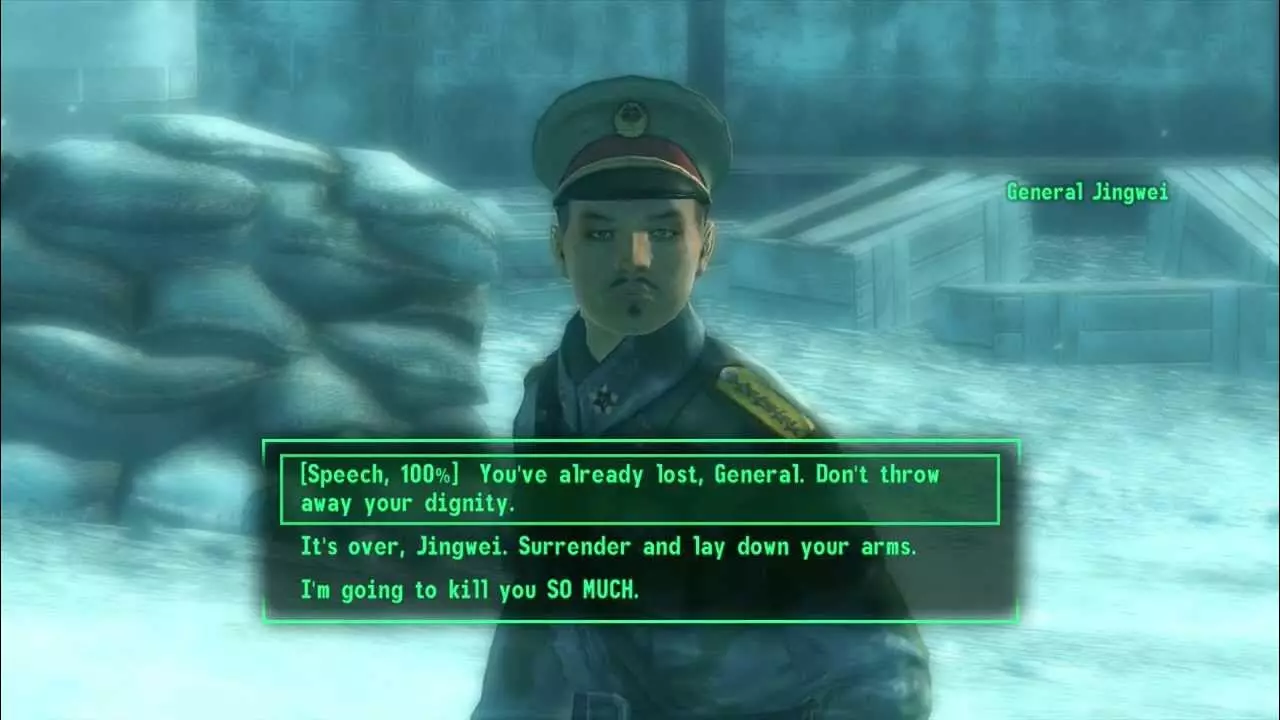
Fallout 3 had 2 "kill yourself" speech options btw, though the one in Anchorage is understandably less talked about.
I did enjoy the Pitt though.
They must have spent 80% of their time creating the
Steelyard and placing those ingots though.


 : You have to find your father.


