Fun facts!

  • Want to keep track of this thread?
    Accounts can bookmark posts, watch threads for updates, and jump back to where you stopped reading.
    Create account
Charles Darwin has a famous quote relating to his hatred of barnacles.
"I hate a Barnacle as no man ever did before"
>t. Charles Darwin
PBS Eons did a great video going into this quote and why it occurred(they also did a great video covering his final book on worms). It was largely due to how complex and odd barnacles are and his attempts to better classify them within his natural philosophy. Earlier naturalists had classified them as mollusks with more recent discovery(relative to Darwin's time, from William Thompson) having been made that suggested they were actually crustaceans due to their planktonic, larval life stage(s).

Darwin's work did however provide a great deal of insight into barnacles as a group, even if they did frustrate him to no end. It's no wonder that barnacles would've been a troubling thing for Darwin though as many species of barnacles are very alien or odd. In particular parasitic barnacles scarcely even seem like animals. The Rhizocephala(meaning "root head") being the prime example. They're a group of parasitic castrators, meaning that they either hinder reproduction greatly or completely castrate their host whilst parasitizing them. In the case of this group however they most often destroy the gonads of their hosts and form large, root-like extensions of themselves throughout them as this depiction shows.
800px-Haeckel_Sacculina.webp
For many crabs they'll also form a large mass, seen in that depiction as well, on their pleon(their tail, in true crabs this is folded up under the belly) where they would otherwise carry their eggs. In both sexes for the hosts of Sacculina genus individuals they are feminized and seem to take care of that mass in place of eggs as if it were their own young. Males who have been infected and then have the parasite removed will not regenerate their testes but instead regenerate ovaries in their place, showing that the impact of the parasite is very strong in regards to things relating to sexual development and hormones.

Despite the oddities of the Rhizocephala though, they are most definitely close relatives to barnacles and their internal anatomy helps to reveal that. Weirder still is that they're not the only kind of close relative to the common barnacles we know that have evolved this tree-like and parasitic life plan. Dendrogaster(meaning "tree stomach" or "tree belly") is a close relative of barnacles, in fact the clade(Ascothoracida, which contains Dendrogaster and also Laurida which also are like Dendrogaster) they're from are currently believed to be the closest relatives of barnacles. For Dendrogaster specifically they parasitize starfish and form these branching structures within them. Here's a picture of one inside of a dissected starfish.
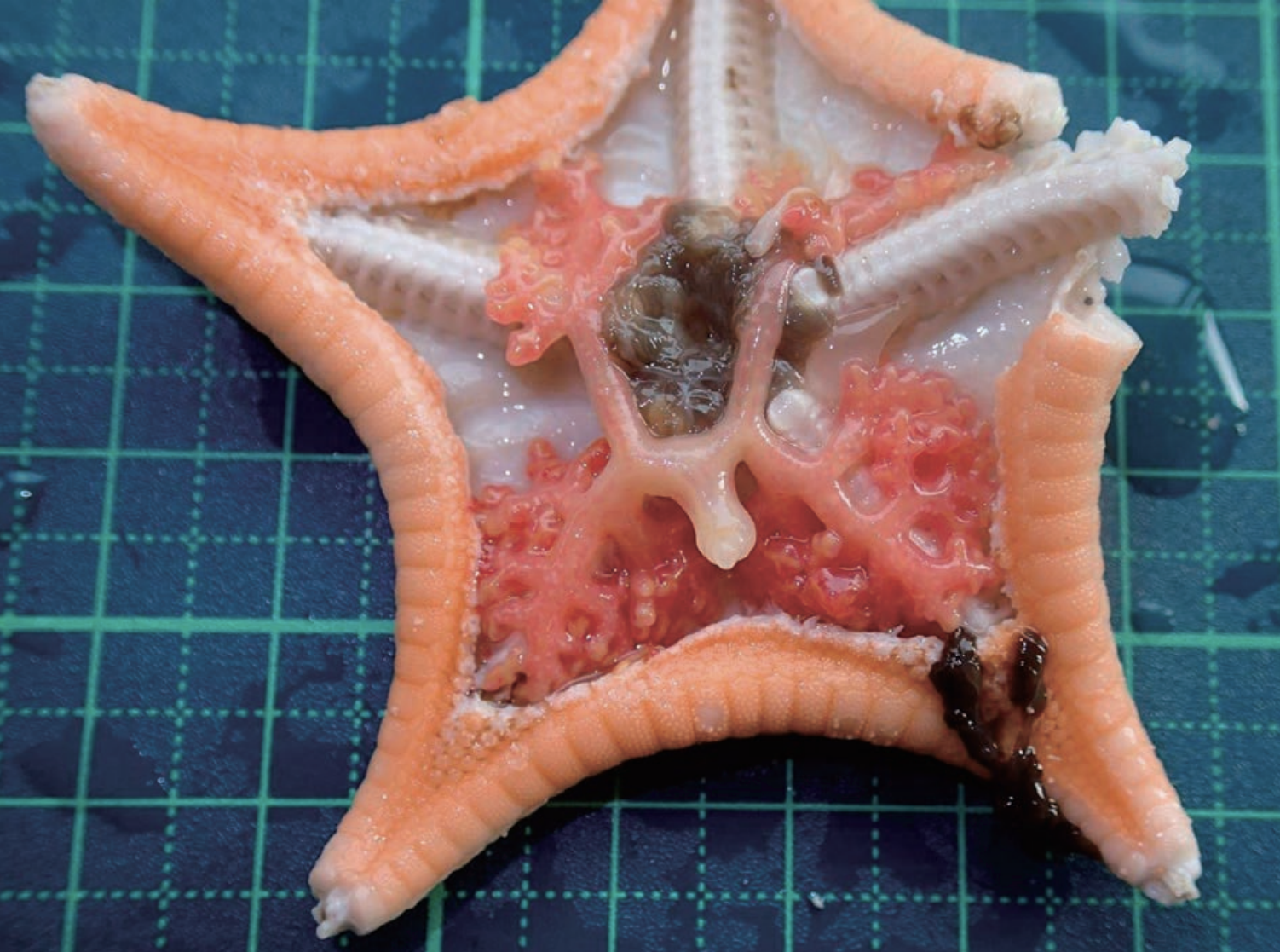
infection.webp

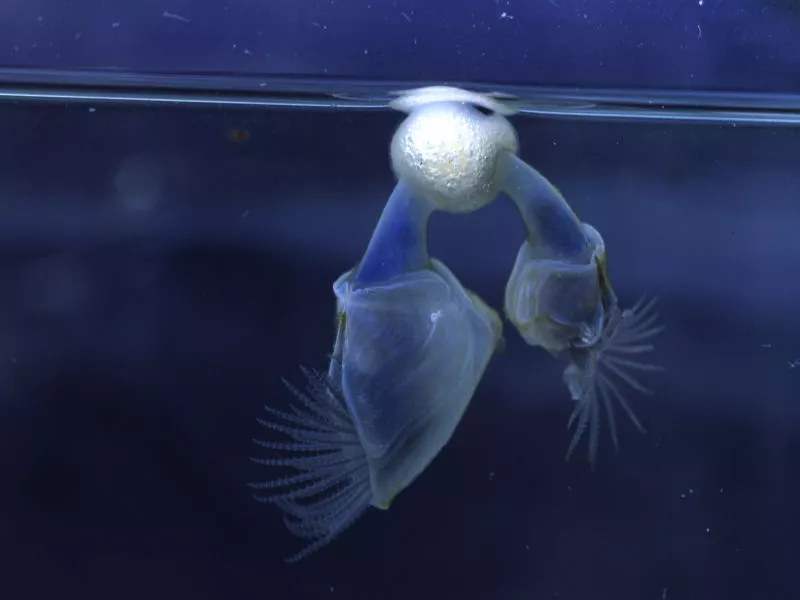
For something less horrific though, we have the Buoy Barnacles :). They're pleustonic(meaning they live on/at the surface of the water) barnacles that float around and filter feed. They're also blue.
o_dosfas.webp
Barnacles also have the longest(and I think even largest) penis to body size ratios of any animal(s). Many barnacles can have penises 8x their body length. This is because barnacles need to be able to reach their penis into another barnacle in order to mate and their sessile lifestyle makes it pretty much impossible without a large tentacle penis. To my knowledge most barnacles are hermaphrodites too so just about every barnacle you see has a massive dick that it's hiding inside its shell.
 
many species of barnacles are very alien or odd.
A long standing mystery in the barnacle clade is the so-called Y-larva. These are nauplius and cypris larvae whose adult forms have never been found (nauplius larvae are common among crustaceans but cypris larvae are typical of barnacles). Treatment of the Y-larva with molting hormones yields a worm-like form, similar to the infective form of rhizocephalans, so one can surmise the adult is a parasite. But we have yet to find the adult form or its host(s).

There used to be a Youtube video that shows the molting process but I can't find it.

The Chinese call rhizocephalans "crab slavers" (蟹奴). Even they might not be aware of the life cycle of this alien-like parasite, they know it controls the behavior of crabs. Parasitized crabs are reputed to reek and even the Chinese don't eat them.
 
Last edited:
A long standing mystery in the barnacle clade is the so called Y-larva. These are nauplius and cypris larvae whose adult forms have never been found (nauplius larvae are common among crustaceans but cypris larvae are typical of barnacles). Treatment of the Y-larva with molting hormones yields a worm-like form, similar to that of rhizocephalans, so one can surmise the adult is a parasite. But we have yet to find the adult form or its host(s).
The more I'm reading into them, the more questions I have. I have a few hypotheses so far but I still need to read the papers the wikipedia article has to see if there's anything to it. One thing that I'm wondering is if the slug-like form isn't itself actually not a parasite but instead something along the lines of microfauna for sargassum(as they're found mostly in neritic areas from what I'm reading). The other idea is that they become gastro-intestinal parasites and my final hypothesis is that they're actually very neotenic and can actually breed without metamorphosizing past that cyprid state but that they need a specific trigger for it. I'd be curious as to how they'd respond to sex hormones instead of molting hormones.

In that final idea it'd maybe explain the more slug-like form, as the genes for a further metamorphosis may have degenerated. All of this reminds me of the mystery with Dendrogramma though.
Dendrogramma_enigmatica_sp._nov.,_holotype.webp
They've popped up a few times and genetic analyses show that they seem to be within siphonophorae. The problem is that no intact colony has been found yet. My little hypothesis is that they're actually benthic(as many have been found from benthic trawling and their similarity to various Ediacaran fauna as noted in the article would be convergent then) and non-colonial. It actually wouldn't be too out of the realm of possibility for a cnidarian or cnidarian-like animal to evolve to be some kind of weird, largely flat, benthic crawler. Placozoans are actually most closely related to cnidarians from what more recent studies have found. It makes sense in that their larvae are planula(a kind of flat clump of cells that drift and then crawl around on a surface and usually then cements itself down to become an adult) and very similar to placozoans. Placozoans are extra weird though since a lot of them reproduce via fission.
Trichoplax_adhaerens_photograph.webp
Exodigestion_in_Trichoplax_adhaerens.webp
All sorts of crazy life can come about from degenerated forms, although Placozoans may not be true degenerates and instead just a very early split that's closer to the cnidarians than bilaterians. The real degenerates amongst the cnidarians are the Myxozoans that I covered before that are microscopic parasites.
 
The Khanate of Sibir was a state that existed between 1468–1598 in Western Siberia. Being controlled by the Muslim Tartars, it was the northernmost Islamic state to have ever existed until being conquered by Russia. At its northernmost point it was further north than Helsinki, Finland.
IMG_6715.webp
 
'
From this profile post(I can't directly add those quotes :( ):
Eufriesea_purpurata_lat.webpUnpinned_Eufriesea_purpurata_dorsal.webp
Eufriesea purpurata is a species of eusocial orchid bee common in northeastern South America, particularly in the Amazon basin. It is an important pollinator of various wild plants, and it is noted for its attraction to various synthetic compounds used by humans, including some insecticides. In the late 1970s, males of the species pestered an indigenous Amazonian community whose palm-leaf houses had been sprayed by the government with DDT, which the bees found attractive.
When asked if the bees died, I added:
Nah, to my knowledge they were totally fine. It seems they've got natural immunity to some natural poisons that are similar to those insecticides, so they're resistant/immune to those too. Apparently they would just keep coming back over and over again for more :).
mmm flowers.webp
Volcanic eruptions can also create lightning within their ash clouds. The pictures of volcanic lightning are all really cool too.
Perfect-Fear-Volcanic-Lightning.webpRinjani_1994.webpLightningL.webp
Airships are really cool. However the two best lift gases out there are hydrogen(which is flammable, explosive in the right conditions and also corrosive from both hydrogen embrittlement(hydrogen causing pockets of itself in a material) and chemical reactions) and helium(which is rare). There is another option than either of these lift gases though with an even higher buoyancy contribution per unit volume... A vacuum :). This kind of vessel is called a vacuum airship and has been thought of for centuries now. Here's a depiction of one from an age gone by back in 1670.
Flying_boat.webp
The problems with manifesting these comes from the materials to make the vacuum portions. However, I see these kinds of airships as being incredibly useful as pseudo-satellites. Most of these pseudo-satellites are basically just very light, unmanned aircraft. It's actually kind of baffling how little I've seen or heard of any kind proposed that were airships pre-2000s too. Here's a video from the wiki showing off a pseudo-satellite made by NASA.

I'll try to not just talk about my ideas too much, but these kinds of vacuum airships may be one potential product of a future space industry. Manufactured in space/low Earth orbit and then lowered down into the upper atmosphere where the pressure differential is not so much of an issue(compared to sea level for example). Pseudo-satellites can function in many ways just like a regular satellite but with less risk from micro-meteorites, the Van Allen radiation belt, solar flares or contributing to the very horrible possibility of Kessler Syndrome. They also have some potential applications relating to interacting with the atmosphere that a normal satellite is not capable of doing. I'll spoiler one idea relating to that that I've had.
One idea I had(and thought about posting in the conspiracy theory thread or making a deep thoughts thread about climate solutions and adding this there) was actually for a hybrid airship that was solar powered to clean up CFCs from the upper atmosphere whilst also producing ozone to fill in the ozone hole(s) up there. Ozone is actually quite energy cheap to produce with modern technology. If I remember correctly one figure I saw for making ozone from atmospheric oxygen was like 20~ joules per gram of ozone. Also the bottom of the vessel can also have a rectenna covering the whole of it to allow for remote power transfer from a microwave emitter on the ground to power it at night(or Antarctic winter when there is no daylight). Rectennas can get something like 70% efficiency doing something like this, which is really good and heat is not so much of an issue over a large surface area like this in high altitude and cold conditions.

You can actually kind of combine the ozone production with thrust for the vessel too by using ionic wind for both the generation of ozone and thrust. Most ozone generators you'll find actually use corona discharges(which high voltage ionic wind thrusters will make plenty of) to produce their product. There has also been research into using ionic wind to propel aircraft too. Here's a video actually of a prototype plane using ionic wind for its propulsion:
The overall idea though is to have an air intake with a plasma discharge to break apart CFCs that then pumps the either the resulting cooled gas or the plasma itself into water with some kind of dissolved mixture to bind with the fluoride and chloride ions as well as to try and trap any fluro- or chloro- compounds after that plasma cleaning stage. Then the air that escapes from that water trap is hit with a corona discharge and ejected out of the back to propel the ship forward. This would allow for the vessel to consume CFCs and trap the harmful fluorine and chlorine atoms so they can't destroy more ozone as well as leaving a trail of ozone behind it.

Now for some napkin math to show the feasibility. According to what I could find on google the ozone hole in our atmosphere is something like 26 million square kilometers large and the ozone layer is 3 mm thick(going by the 300 dobson units measure, which is how much ozone is above an area of the planet's surface. 1 dobson unit is 0.01mm worth of ozone total). This nets us a volume of 78~ cubic kilometers of the ozone layer to restore. Now we'll just assume that we need ozone at concentrations relative to sea level and 30c, so using the ideal gas law we find that we'll get 39.6 mols of ozone per cubic meter, which we'll round up to 40.

So a cubic kilometer is 1 billion cubic meters, this means we'll need 40 mols x 78 billion cubic meters to get us 3.12 trillion mols of ozone. Now if it takes 20 joules to create 1 gram of ozone and ozone has a molecular weight of 48g/mol, then that means 1 mol of ozone requires 960 joules of energy to produce on average. This means we need 3.12 trillion mols x 960 joules of energy to meet out just our ozone needs, which is equal to 2.9952 quadrillion joules of energy. Sounds impossible, right? Well 1 kilowatt hour is 3.6 million joules of energy and the average US household consumes something like 30 kilowatt hours a day. To meet our ozone requirements we'd need 832 million kilowatt hours or 832 gigawatt hours of power.

That still sounds really big, right? Wrong. The entire world's electricity usage in 2022 was 24,398 terawatt hours according to what I found on wikipedia. For reference that's over 29 thousand times the energy needed in this scenario to replenish the ozone hole. Now even without removing the CFCs first(to which the energy usage for that hasn't been accounted for in this napkin math), we could fix the ozone hole still for something along the lines of some multiple(maybe even upwards of 100x) what it would take to replenish the ozone hole(although we will likely need at least a multiple of this 832 gigawatt hour figure anyhow due to CFCs we miss degrading ozone we produce), as CFCs do get degraded by ozone but it may take something like 100 mols of ozone to degrade 1 mol of CFCs(it depends on the kind of CFC). Even doing that would still be cheaper energy wise than the entire electricity budget of the world over the course of a year, 3 years ago, by more than a few orders of magnitude. This is also whilst using very, very pessimistic estimates.
 
I have a general life rule that Ostrich shaped birds are not to be fucked with. They will find a way to hurt you.
Even roosters have killed people before, especially in relation to cockfighting. In those cases people will attach razors to their feet to make the fights bloodier, but roosters can and will also attack even their owners. However there has been a murder case from a rooster who wasn't armed at all. It was from a Brahma breed rooster which is a large breed of chicken. Here's a picture of a Brahma chicken being held by a kid.
brahma_and_child_525x700.webp
 
Even roosters have killed people before, especially in relation to cockfighting. In those cases people will attach razors to their feet to make the fights bloodier, but roosters can and will also attack even their owners. However there has been a murder case from a rooster who wasn't armed at all. It was from a Brahma breed rooster which is a large breed of chicken. Here's a picture of a Brahma chicken being held by a kid.
View attachment 7662814
I remember seeing a video once of a hawk swooping down and attempting to kill a hen only to get jumped by a rooster which proceeded to kill it.
 
I remember seeing a video once of a hawk swooping down and attempting to kill a hen only to get jumped by a rooster which proceeded to kill it.
Yeah, roosters actually fulfill a role like that of a male lion in a pride. They're protectors of their flock and also watchmen; it's not just a harem for them. When roosters spot predator(s) they'll let out a warning call so that the hens can seek safety and if anything threatens their hens or chicks then they'll risk their lives to save them. Here's a video of a rooster warning call:
 
The Chinese call the rooster "The Bird of Five Virtues":
  1. Its comb is like a scholar's hat -- the virtue of literacy flair.
  2. Its spur is a formidable weapon -- the virtue of martial prowess.
  3. It never backs from a fight -- the virtue of courage.
  4. It calls its companions when it finds food -- the virtue of generosity.
  5. It crows when the sun rises -- the virtue of trustworthiness.
 
The most heavily populated island in the world is an island belonging to Columbia. It's called "Santa Cruz del Isolte" and was apparently settled by Afro-Columbian fishermen and their wives. For generations they've been building on the island and living there and now have a small tourism industry where they have a kind of aquarium with some sea turtles and sharks that people are allowed to swim in.

The island reported stinks, is full of trash and is only about 3 acres in size. They throw lots of their trash in the sea and have had more recent issues due to fish and shellfish stocks drying up. They get all of their electricity from solar power and small generators and are apparently very communal. Apparently the families are still very well above replacement fertility despite how crowded and crappy the island has gotten.
Santa_Cruz_del_Islote_view.webp
At one point a concrete cross apparently washed up on the island and is now displayed in the center of the island, it also earned the island its name.
El_patio_de_recreo_es_la_calle_principal_(53558644793).webp
A Youtuber has done a tour and small documentary covering the island, in which it took him roughly 2 minutes to walk between the two farthest points.
It astounds me how these niggers haven't done any basic improvements to deal with their trash situation. They could solve three problems(their polluted waters, trash issue and power) by burning their garbage for power. They could even improve on their energy production if they actually worked together to have all of their roofs using solar panels instead of just one communal area.

If their waters were actually clean and properly maintained then their little tourism industry could actually thrive and they could make an even better living for themselves as an odd little community in the middle of the sea.

Beyond that, they could actually be using their reef resources to properly farm both fish and crops. Individual pens for keeping even just spiny lobsters in would produce a good deal of food for them and the lobsters would largely filter feed. If they were actually planning anything properly this could be such a nice place instead of a fly and shit infested garbage heap.
 
The genus of mites, adactylidium, has a remarkable reproduction cycle.
All of its offspring hatch inside the mother where its several female spawn are impregnated by a singular male sibling while still inside the womb.
The now pregnant mites then proceed to chew their way out of the mother, consuming her in the process.
 
The genus of mites, adactylidium, has a remarkable reproduction cycle.
All of its offspring hatch inside the mother where its several female spawn are impregnated by a singular male sibling while still inside the womb.
The now pregnant mites then proceed to chew their way out of the mother, consuming her in the process.
That reminds me of the mystery starfish that was found in Antarctica, Paralophaster ferax. To my knowledge only one adult specimen has been identified and originally it wasn't very interesting. It was only after it was cracked open to try and look inside for its stomach contents that its babies were found within it. It's not the only starfish that broods young, but it is a species that's new that does it and it does so internally. Here's an article about them.
img_2715.webp
It's very likely that the young either have to burst out of their mother or instead consume parts of her and then escape. Matriphagy is pretty crazy. There's actually a large group of spiders that utilize matriphagy and they bare a resemblance to jumping spiders despite being a web-spinning variety. They're the velvet spiders. The mothers will liquify her own cells and feed them to her young until she finally succumbs and dies. That group of spiders by the way has a weird habit of evolving sociality, which I don't think is unrelated.
images.webp
 
The most heavily populated island in the world is an island belonging to Columbia. It's called "Santa Cruz del Isolte"
*most densely populated island in the world. It only has about 800 people. I believe Java is actually the most heavily populated island.

In other heavily populated island news, the city of London in the UK is so massive that it is actually sinking into the ground about 1-2mm per year.
 
Last edited:
*most densely populated island in the world. It only has about 800 people. I believe Java is actually the most heavily populated island.
That's my bad, you're right. I hate imagining how many people are on Java too. Speaking of London being claimed by the Earth slowly though, just off its coast there used to exist a large landmass that actually connected England to the European mainland. It existed due to the ice sheet covering most of Europe pushing down part of its continental plate and when the ice sheet melted/retreated it took time for the continental plate to shift back down(This would be glacial isostatic depression on part of the continental shelf followed by post-glacial isostatic rebound). There was also the added effect of rising sea levels from the melting glaciers. The land mass is named after the bank, dogger bank, and so is called "Doggerland".
Doggerland.webp
There's mammoth tusks and (edit:bits of*, not whole trees obviously) trees down there too, still preserved in the sediment. Parts of Europe are also still rebounding from those ice age glaciers, mainly places like Norway and Scotland from what I remember.
 
Last edited:
Before he created Godzilla and Ultraman, legendary special effects artist Eiji Tsuburaya worked on propaganda films for the Japanese army. One of them, The War at Sea from Hawaii to Malaya, featured a scene depicting the bombing of Pearl Harbor. The miniatures and setpieces for the ships and harbor were so convincing back then, General Douglas MacArthur believed that the Japanese had somehow gotten footage of the actual attack, so he confiscated the film to be shown on American newsreels.
 
Hello Kitty has a superhero alter-ego named Ichigoman, and it just looks like shirtless Hello Kitty (she's wearing a white shirt).
1753667816448.webp
Also, Hello Kitty's real name is apparently Kitty White and she was born in London.
 
Before he created Godzilla and Ultraman, legendary special effects artist Eiji Tsuburaya worked on propaganda films for the Japanese army. One of them, The War at Sea from Hawaii to Malaya, featured a scene depicting the bombing of Pearl Harbor. The miniatures and setpieces for the ships and harbor were so convincing back then, General Douglas MacArthur believed that the Japanese had somehow gotten footage of the actual attack, so he confiscated the film to be shown on American newsreels.
For another early work by Tsuburaya from World War II, there’s Colonel Kato’s Falcon Squadron, which similarly blends footage of real military vehicles (in this case, both Japanese fighter planes and a handful of captured Allied aircraft) together with miniature sets through compositing. It’s definitely very interesting to see the techniques that would later be used to great effect in the first Tokusatsu works be introduced and refined during this period of time.
 
Back
Top Bottom