
- Joined
- Apr 12, 2021
Chinese EVs aren't doing so well.
BYD just laid off 100,000 employees:
and Tesla overtook them as the largest EV seller:
BYD just laid off 100,000 employees:
Source (Archive)BYD cuts 100,000 jobs, workforce down 10%, the new battleground for EV growth
Adrian Leung
Mar 31, 2026 8:47 AM CEST

BYD 2025 revenue reaches 8039.6 billion yuan (1,123 billion USD), despite profit narrowing 19 %. Credit: CNC
BYD’s workforce fell to 870,000 employees in 2025, a reduction of roughly 100,000 people, or about 10 %, according to ifeng. The company attributed the decline to restructuring, efficiency improvements, and cost management measures rather than weakening demand. The reduction comes as automakers increasingly focus on operational efficiency as the next stage of EV competition.
Revenue and deliveries reach new highs
BYD reported 8039.6 billion yuan (1,123 billion USD) in revenue for 2025, alongside 4.60 million vehicle deliveries, according to the NBD. Overseas deliveries reached approximately 1.05 million units, according to Sina reporting, marking the first time the company surpassed the 1-million-unit mark in exports.
Profit declines amid pricing pressure and investment
Net profit totalled 326.2 billion yuan (45.6 billion USD), down around 19% year on year. The decline was attributed to pricing pressure in the domestic NEV market and continued investment in vehicle and battery technologies.
BYD maintained R&D spending of 634 billion yuan, reflecting ongoing development in electrification, battery systems, and charging infrastructure despite margin compression.
Overseas expansion supported by new battery technology
BYD continued to expand internationally with a broader vehicle lineup and increasing export volumes. The company launched Blade Battery 2.0 with Flash Charging 2.0 on March 5, 2026. The system enables charging from 10 % to 70 % in about 5 minutes and from 10 % to 97 % in 9 minutes under standard conditions.
The rollout of flash charging infrastructure coincides with BYD raising its 2026 export target to 1.5 million vehicles, a 15 % increase from its earlier goal. The higher target reflects the company’s focus on overseas markets to support growth amid domestic competition.
The domestic market shows short-term fluctuations
Domestic NEV sales declined 41 % in February 2026, according to CarNewsChina, primarily due to seasonal factors linked to Chinese holidays. The decline occurred before the rollout of Blade Battery 2.0, indicating short-term demand fluctuation rather than structural changes in product demand.
Expanded charging infrastructure and new battery technology are expected to support more stable demand in the coming months.
Performance overview
BYD’s 2025 results combine workforce reduction, revenue growth, and continued technology investment. Its position among the global top 10 automakers and the rollout of next-generation battery systems, alongside a higher export target, reflect simultaneous adjustments in cost structure and international expansion.
and Tesla overtook them as the largest EV seller:
Source (Archive)Tesla reclaims world's biggest BEV maker title from BYD in Q1 2026
BYD's historic overtake in 2025 has been reversed for now.
Simon Alvarez
Apr 2, 2026

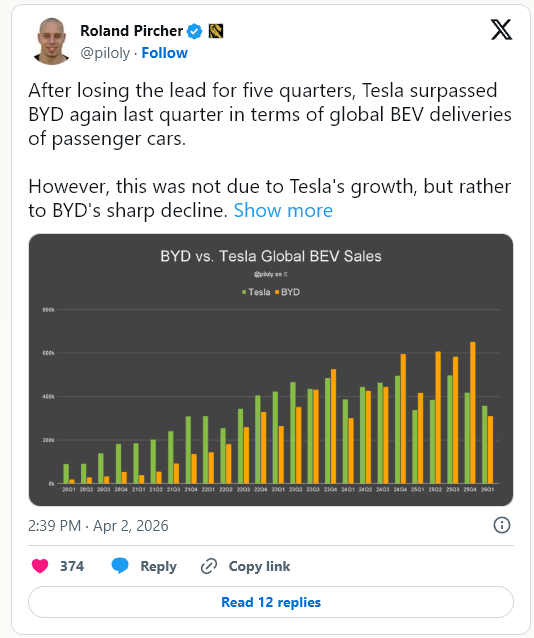
EVwire brief: Tesla reclaimed the global battery-electric vehicle lead in Q1 2026 by 47,634 units, reversing BYD’s historic 2025 overtake.
Tesla delivered 358,023 vehicles in Q1 2026, up 6.3% year-over-year.
BYD reported 310,389 BEV sales in the first quarter, a 25.46% decline.
The shift follows a pivotal change in 2025, when BYD became the first company to surpass Tesla in full-year pure BEV sales, reaching 2,256,714 units compared to Tesla’s 1,636,129.
Tweet (Archive)
Thanks to vehicles like the Model S, then the Model 3 and now the Model Y, Tesla led global BEV sales consistently since the 2010s. With BYD’s shift to pure NEVs, however, the Chinese manufacturer started seeing rising BEV sales.
In 2024, Tesla delivered 1,789,226 vehicles, narrowly ahead of BYD’s 1,764,992 pure BEVs.
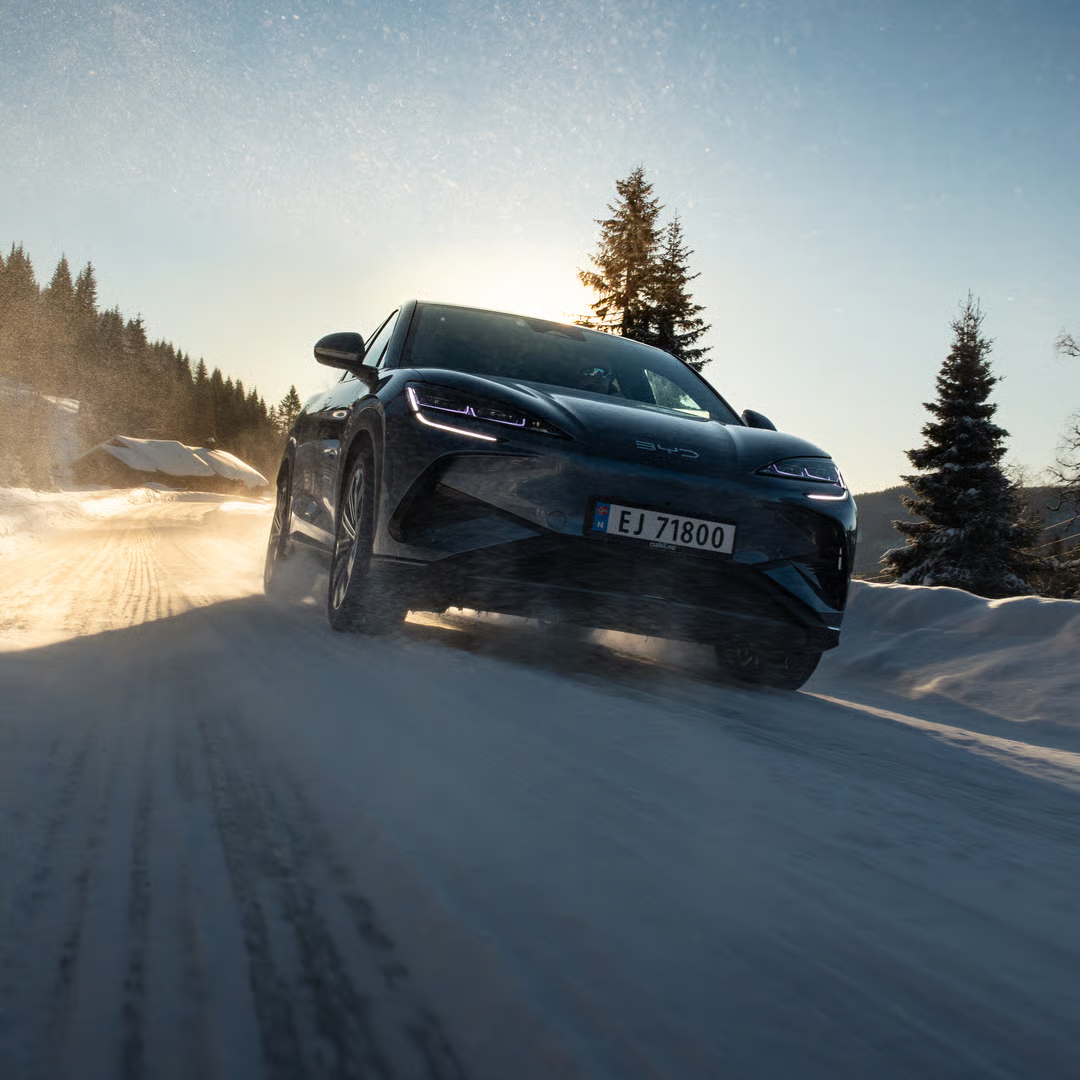
BYD’s BEV sales saw a sharp 25.46% decline in the first quarter
That balance shifted in 2025 as BYD’s BEV sales grew 27.9% year-over-year, while Tesla’s deliveries declined 8.6%. This marked the first annual lead change in the modern EV era.
Tesla and BYD’s Q1 2026 results indicate that global BEV leadership is now fluctuating.

The majority of Tesla’s sales is comprised of the Model 3 and Model Y
Tesla and BYD’s production scale and footprint
BYD operates at a significantly larger scale than Tesla in terms of vehicle production, producing 4,545,423 passenger vehicles in 2025 across roughly nine major production bases in China, alongside expanding international plants in Brazil, Thailand, and Hungary. BYD produces both BEVs and plug-in hybrids.
Tesla, by comparison, produced 1,654,667 vehicles in 2025, with 1,600,767 units coming from the Model 3 and Model Y. Tesla’s manufacturing footprint is focused only on four factories in Fremont, Shanghai, Berlin, and Texas.
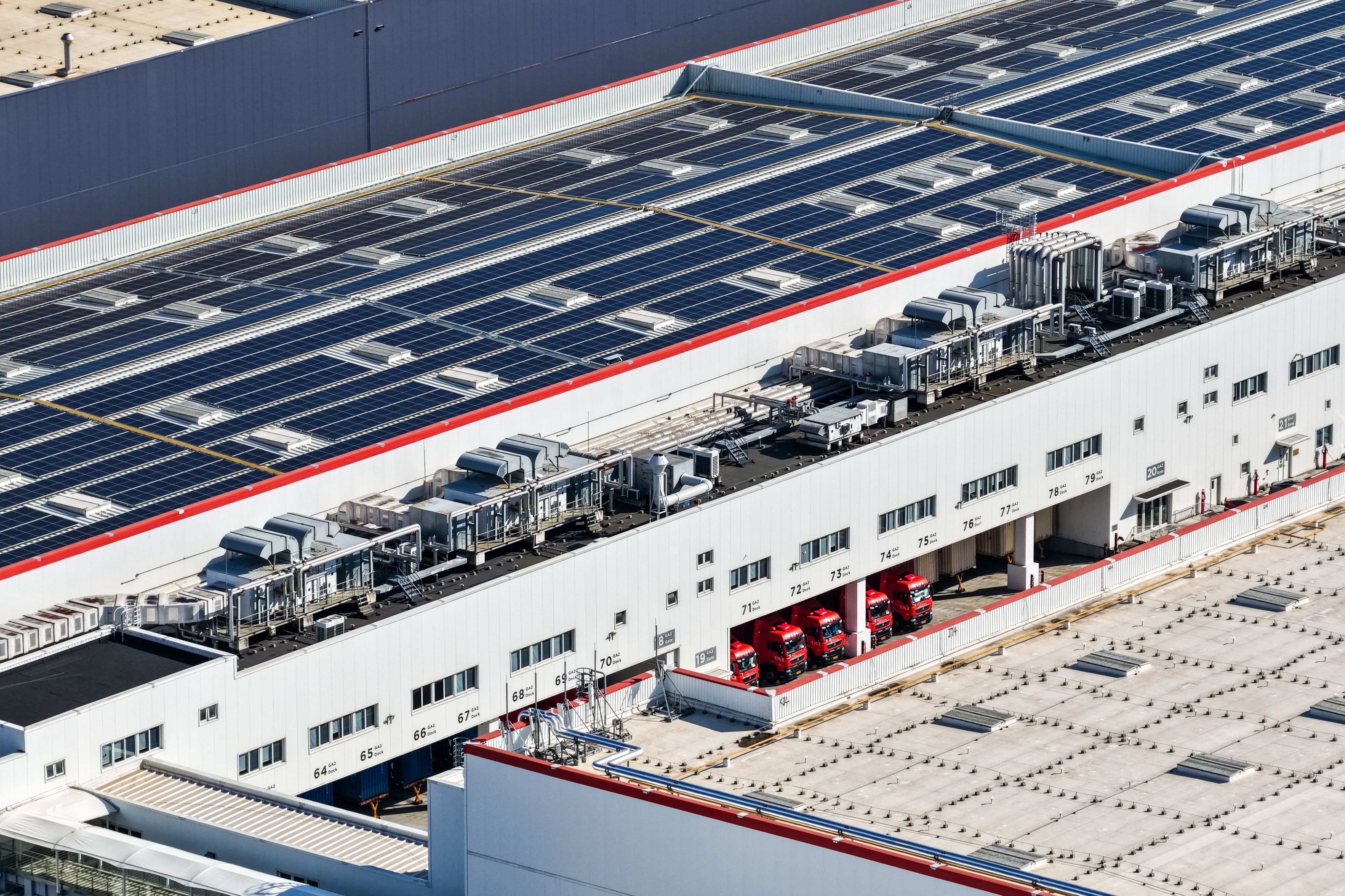
Tesla has significantly fewer factories compared to BYD
While BYD leads Tesla in raw manufacturing, Tesla continues to lead in per-unit profitability despite lower total volumes.
In 2025, Tesla generated approximately $7,564 in gross profit per vehicle, supported by higher global average selling prices.
BYD reported an automotive gross margin of 20.5%, but lower pricing resulted in roughly RMB 29,256 (about $4,250) in gross profit per vehicle. That’s about 43% less than Tesla’s margins.
Source: Tesla Investor Relations and BYD Production and Sales Volume Report


